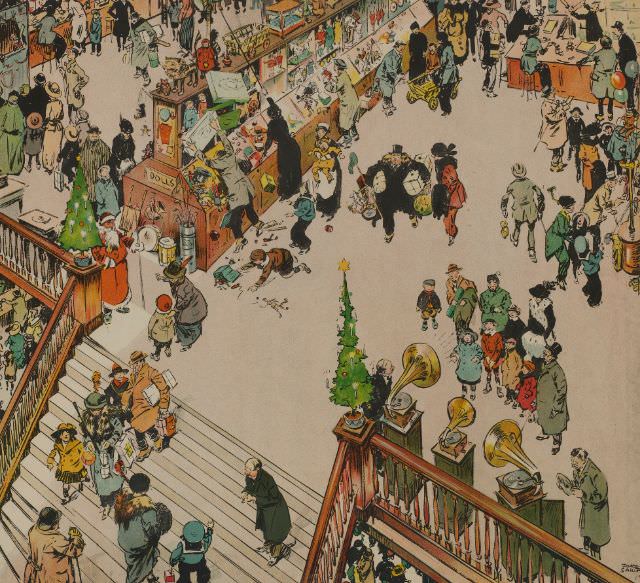
Toy counters stretch away in a bright, bustling arcade, where glass cases and stacked displays tempt shoppers at every turn. Children hover at the edges, some tugging at sleeves, others already absorbed in small wonders, while adults in heavy coats and hats navigate the aisles with measured purpose. The scene has the lively, slightly compressed energy of a London crowd, rendered with an illustrator’s eye for movement and little domestic dramas.
Along the walkway, seasonal touches—small decorated trees and festive trim—hint at the kind of shopping day that turns an ordinary errand into an outing. Brass-horn gramophones stand like proud attractions, suggesting that “Toyland” is as much about spectacle as it is about buying: sound, color, and novelty bundled together. Nearby, a doll display and toy animals compete for attention, and the whole floor reads like a map of desires—what catches a child’s gaze versus what a parent pauses to consider.
As part of “Humours of London,” the artwork leans into observation, finding comedy and charm in the choreography of modern consumption. It’s an inviting window into historical retail culture—department-store leisure, family shopping, and the early twentieth-century fascination with playthings and new technology—without needing a single caption to explain the mood. For readers searching for “Humours of London” art or an “In Toyland” print, this image offers both period detail and the timeless thrill of wandering through a toy department.