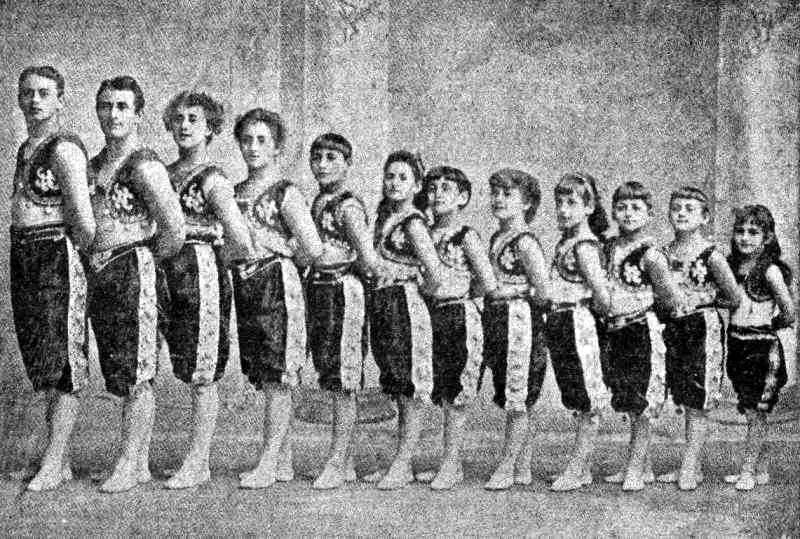
Lined up shoulder to shoulder, the Kremos present themselves like a living measuring stick of strength and training, from full-grown performers down to the youngest child at the end of the row. Matching sleeveless costumes and bare feet suggest a family act built for balance, tumbling, and human pyramids, where uniformity mattered as much as muscle. Even in this posed moment, the slightly turned torsos and steady gazes hint at stage discipline—people accustomed to being watched.
Family acrobat troupes were a hallmark of late 19th- and early 20th-century popular entertainment, when circus bills and variety programs depended on reliable, repeatable feats performed night after night. The title’s emphasis on two generations feels especially fitting here: the photo reads as both portrait and proof of continuity, a tradition taught at home and sharpened under rehearsal. In an era before modern sports academies, this kind of physical culture often grew inside families, where technique, timing, and trust were inherited along with the act itself.
For readers interested in Swiss acrobatics history, vintage circus performers, and early athletic costume design, the image offers rich detail without needing a single captioned name. Notice how the group’s arrangement foregrounds progression—size, age, and experience implied by the lineup—while keeping every performer part of the same visual identity. As a WordPress feature, it’s a striking reminder that “sports” once blended seamlessly with showmanship, and that the Kremos’ legacy was built on both kinship and craft.