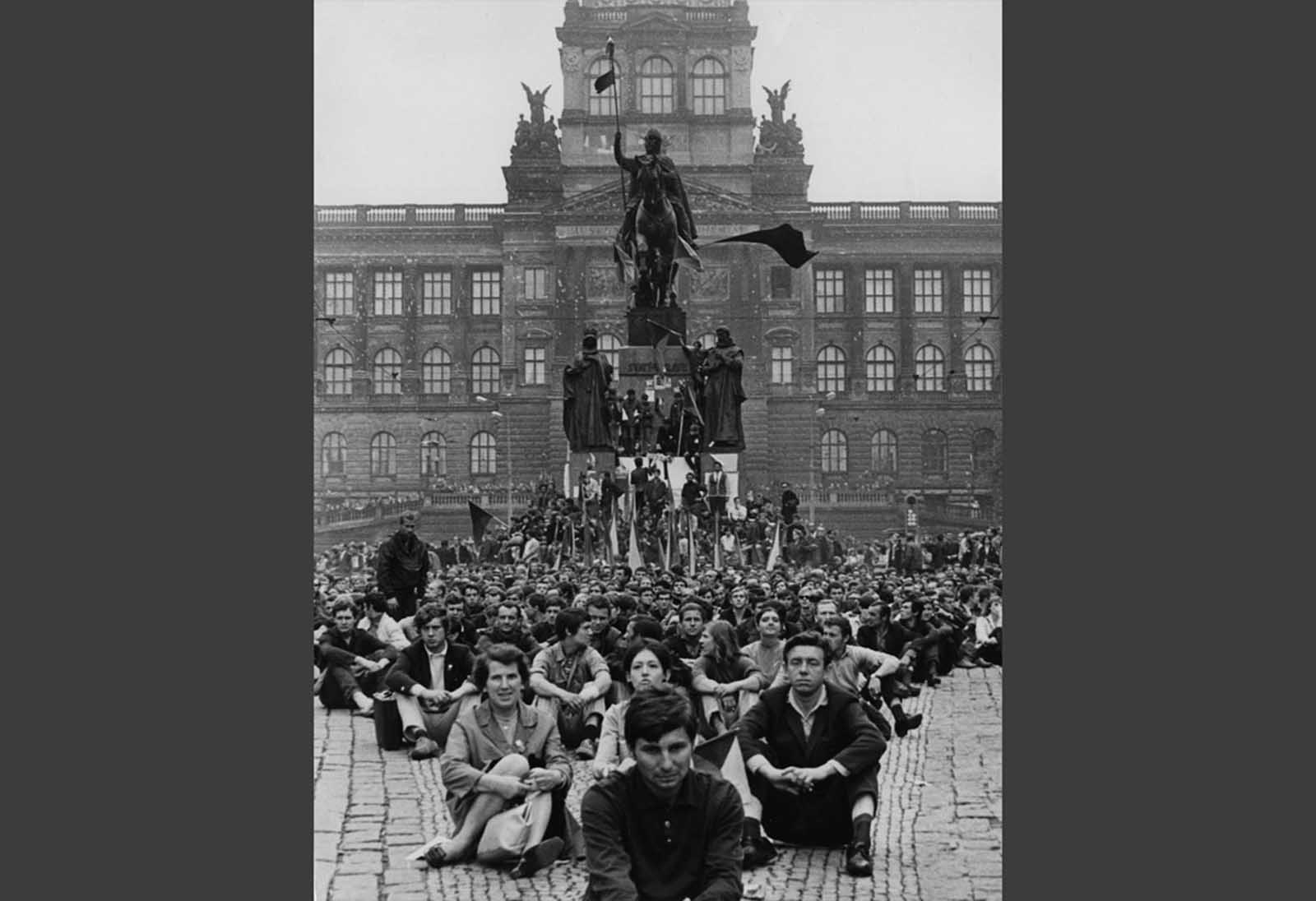
Rows of people sit shoulder to shoulder on the cobblestones of Wenceslas Square, their faces turned forward with a quiet, determined attention. Behind them rises a monumental equestrian statue and the grand façade of a civic building, turning the scene into a stark contrast between stone authority and living dissent. The crowd’s posture—seated, packed tight, and unflinching—reads as a deliberate choice: presence without panic, resistance without spectacle.
Taken on August 24, 1968, the photograph places us in downtown Prague during the tense days following the Soviet invasion, when public space became a stage for mass protest. Flags and banners punctuate the gathering, while the sea of heads suggests numbers too large to dismiss as a fringe. Even in a single frame, the mood carries the weight of occupation and uncertainty, as if the square itself is holding its breath.
As a historical image of the Prague Spring’s aftermath, it captures how civil resistance can look—ordinary citizens using stillness and solidarity as political language. For readers searching for 1968 Prague protests, Wenceslas Square demonstrations, or visual records of opposition to the Soviet invasion, this photo offers a visceral entry point. It reminds us that pivotal moments in Cold War Europe were not only negotiated in offices and barracks, but also lived—together—in the open air of a city square.