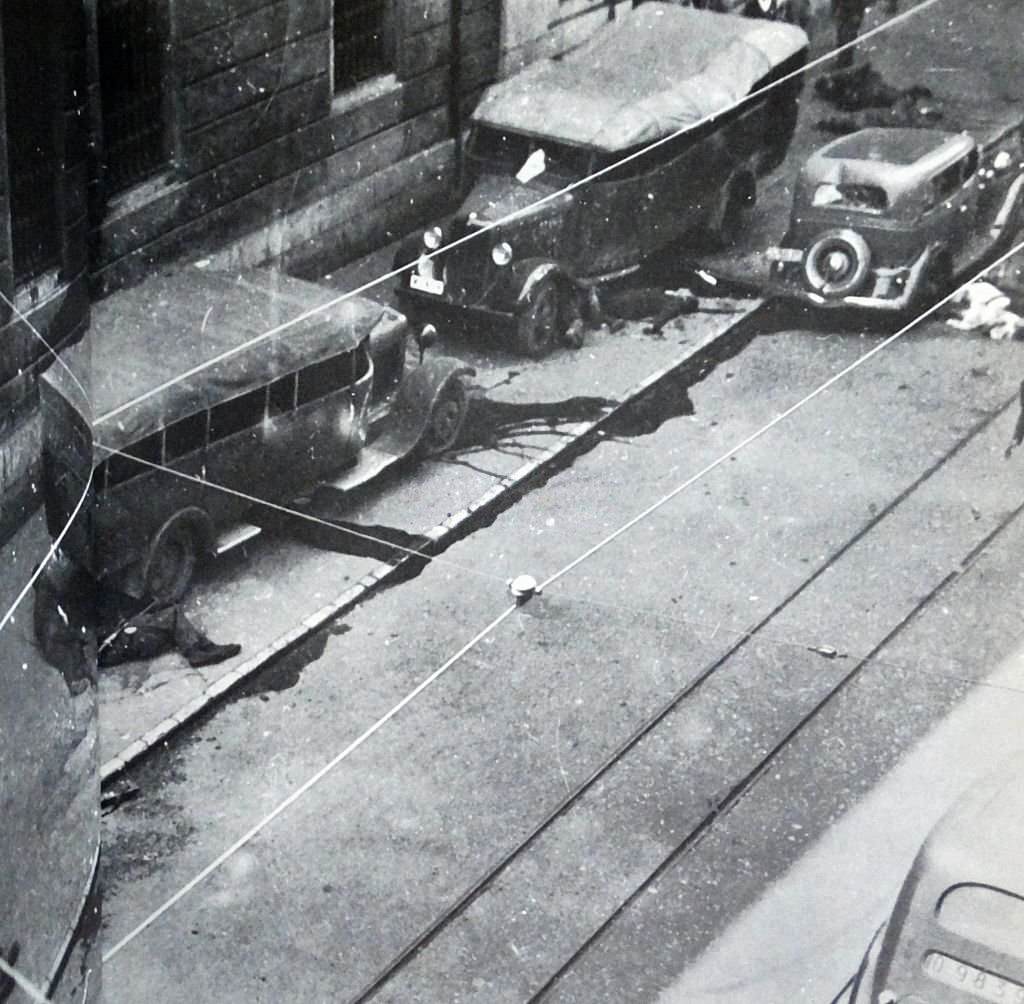
From an elevated vantage point, the street in Gijón becomes a stark ledger of the Siege’s cost: bodies and injured figures lie along the curb beside parked vehicles, their outlines partly swallowed by shadow and grit. Tram tracks run through the center like a reminder of ordinary urban life abruptly interrupted, while overhead wires slice across the scene. The stillness is unnerving—no bustling crowd, no rescue in motion—only the aftermath caught mid-silence.
Civil wars are often summarized through maps and slogans, yet photographs like this insist on the intimate geography of violence: the sidewalk, the doorway, the stretch of road that yesterday carried commuters and deliveries. The cars pulled tight to the building wall suggest a city trying to keep functioning even as danger pressed in, and the scattered debris hints at recent shock and impact. In this frame, the siege is not an abstract campaign but a neighborhood moment where civilians and combatants alike could be reduced to casualties in seconds.
As a historical document, the image adds weight to any discussion of the Siege of Gijón by grounding the event in a recognizably modern streetscape—rails, cables, and everyday transport turned into witnesses. It is a difficult photograph, but its value lies in refusing to let “Civil Wars” remain a distant label; it shows the human cost left on public pavement where anyone might pass. For readers searching the Spanish Civil War’s urban realities, this scene offers a raw, unembellished glimpse of what siege warfare meant for a city’s streets and its people.