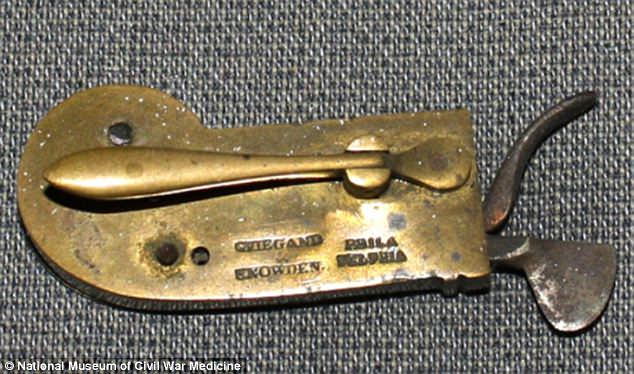
Brass and steel sit side by side in this compact fleam, an instrument designed for bloodletting and made to be carried, handled, and used quickly. The U-shaped blade is housed within a sturdy frame, and the levered mechanism hints at a tool meant to deliver force with precision rather than a surgeon’s slow, careful cut. Even in a simple museum-style photograph, the worn surfaces and utilitarian build suggest repeated use in an era when such devices were part of everyday medical practice.
A spring-loaded action—released by the trigger above—turns the act of opening a vein into a controlled mechanical motion, more akin to a piece of equipment than a hand-held knife. The screw at the base of the lever allowed the user to regulate how deep the blade would bite, a reminder that “standardizing” a procedure sometimes meant adding a few parts and trusting the device. Visible maker’s marks or stamped text on the body offer a tantalizing clue to manufacture and provenance without requiring us to pin it to a single person, battlefield, or exact moment.
Civil War medicine often appears in popular memory as a world of amputations and rough field surgery, yet bloodletting tools like this fleam show how older therapeutic ideas persisted alongside newer practices. For collectors, researchers, and readers interested in medical history, the photo brings attention to the material culture of treatment—what a practitioner could actually hold in the hand, adjust, and deploy under pressure. It’s a stark, intimate artifact that helps explain why nineteenth-century healthcare could feel both ingenious and unsettling, especially in the context of wartime injury and limited resources.