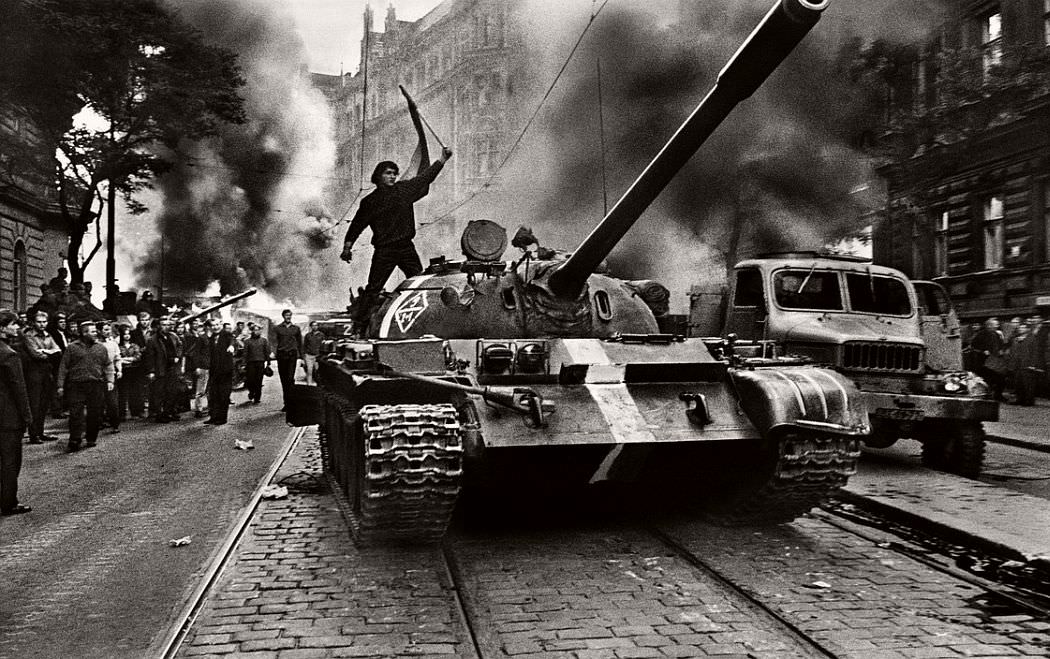
Armored tracks grind along a cobbled city street as a Soviet tank dominates the frame, its long gun barrel cutting through a haze of smoke. Crowds press in on both sides, some watching in tense silence while others edge closer, the urban facades looming behind them like witnesses. The scene is crowded, loud in its implied chaos, and unmistakably Cold War in tone—military hardware inserted into everyday civilian space.
A man stands atop the tank, raised above the street as if trying to reclaim a measure of agency in the face of occupation. Nearby vehicles and the thick plumes suggest confusion and confrontation, the kind of street-level turmoil that defined the Soviet invasion of Czechoslovakia during the Prague Spring of 1968. Rather than a battlefield at the front, the struggle here is public and immediate, where ordinary people meet armored power at point-blank range.
For readers searching the history of the Warsaw Pact intervention, Prague Spring crackdown, or Soviet tanks in Czechoslovakia, this photograph offers a stark entry point into the story. It captures the collision between reformist hopes and imperial control, highlighting how “civil” life becomes the terrain when an invasion unfolds in the heart of a city. The image lingers because it frames resistance not as abstraction, but as bodies, streets, smoke, and steel.