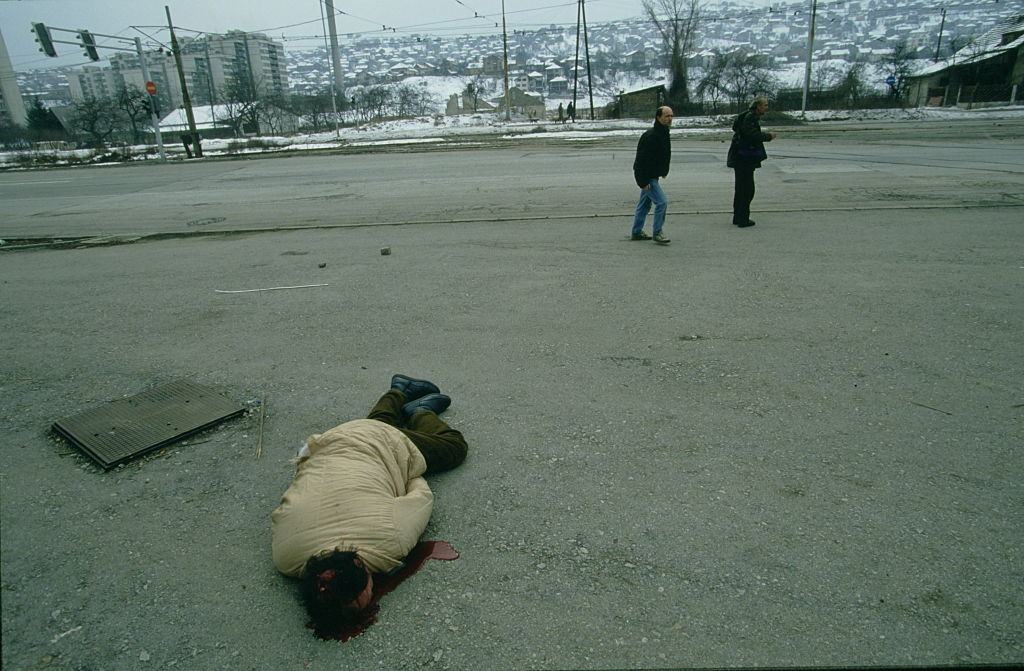
On a cold, open roadway in Sarajevo, a human body lies facedown on the asphalt, a dark stain pooling beneath the head while the city’s hills and apartment blocks sit muted in the distance. Snow clings to the edges of the scene, and the wide street feels unnervingly empty—more like a corridor than a place meant for everyday life. A few small objects on the pavement and the stark spacing of everything in view amplify the sense of sudden violence and interruption.
Nearby, two pedestrians move through the intersection with a cautious, weary pace, keeping distance from the dead and from whatever danger might still linger. Tram wires and traffic lights frame the background like the ordinary infrastructure of a modern city, yet they hang over a landscape turned hostile by civil war. The contrast between routine urban details and the finality on the ground is what makes the photograph so difficult to look at, and so hard to forget.
Sarajevo during the Bosnian Genocide is often remembered through statistics, diplomatic statements, and battlefield maps, but images like this insist on the individual cost. The body becomes a grim marker of how quickly public space can be transformed into a killing ground, where movement, errands, and survival blur into the same risk. For readers searching for historical context on the Bosnian War, Sarajevo siege photography, or the human toll of civil wars in the Balkans, this photograph stands as testimony—quiet, brutal, and painfully real.