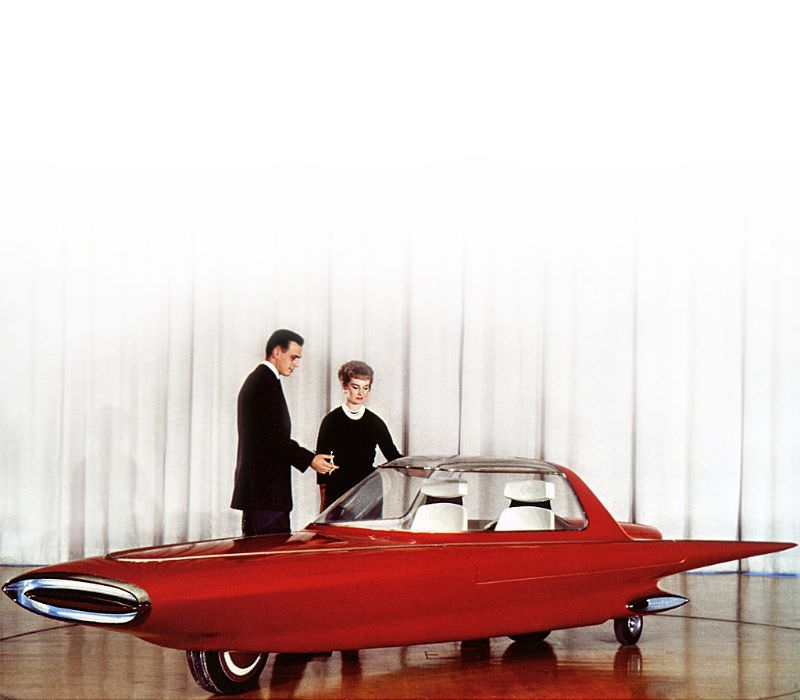
Sleek, low, and unapologetically futuristic, the 1961 Ford Gyron looks like it rolled straight out of a Jet Age daydream. The long red body tapers to a pointed nose and dramatic tailfins, while a wide canopy reveals a bright, minimalist interior. In the photo, two well-dressed onlookers stand beside the car, their attention drawn to the unusual proportions that make this concept vehicle feel more like an aircraft fuselage than a conventional automobile.
What makes the Ford Gyron truly arresting is the idea behind it: a two-wheeled “gyrocar” intended to balance using gyroscopic technology. Instead of relying on four tires planted firmly on the ground, the design suggests a narrow footprint and an engineering gamble—stability achieved through motion and mechanics rather than sheer width. As a research and marketing-purpose invention, it speaks to an era when major manufacturers used bold prototypes to test public appetite for radical transportation solutions.
Seen today, this historical image doubles as a reminder of how optimistic early-1960s design could be, where aerodynamics, space-age styling, and experimental engineering merged into rolling sculptures. The Ford Gyron concept remains a fascinating chapter in automotive history, frequently searched by enthusiasts interested in gyro-stabilized vehicles, vintage concept cars, and Ford’s most daring design experiments. Even in a static studio setting, the car’s shape sells the promise of tomorrow—whether or not tomorrow ever arrived on two wheels.