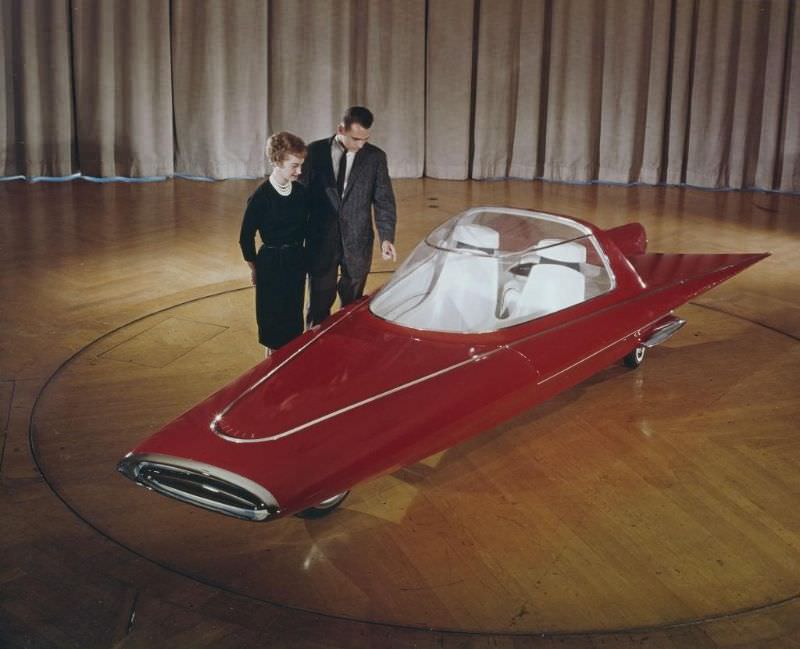
Sleek and low-slung, the 1961 Ford Gyron looks less like an ordinary automobile and more like a jet-age experiment set down on a polished floor. Its bright red body narrows to a needle-like nose, while a clear canopy reveals a stark white, futuristic interior. Standing nearby, a well-dressed couple studies the machine as if it were a promise from tomorrow, emphasizing how much this two-wheeled concept relied on spectacle as well as engineering.
Designed as a gyrocar, the Gyron represented a moment when major manufacturers explored stability through gyroscopic technology and bold design language. The idea of balancing a vehicle on two wheels challenged the era’s assumptions about safety and practicality, yet it also aligned perfectly with early-1960s optimism about science solving everyday problems. Even without technical diagrams, the photo communicates its purpose: a research-driven prototype crafted to test ideas and to capture attention.
For readers interested in concept cars, experimental vehicles, and Ford’s mid-century innovation culture, this image is a vivid reminder that marketing and engineering often advanced hand in hand. The Gyron’s dramatic proportions, aircraft-like canopy, and show-ready presentation suggest it was meant to be seen as much as driven, a rolling conversation piece about the future of mobility. Whether viewed as serious research or aspirational theater, the 1961 Ford Gyron remains an iconic two-wheeled invention from an era that loved daring solutions.