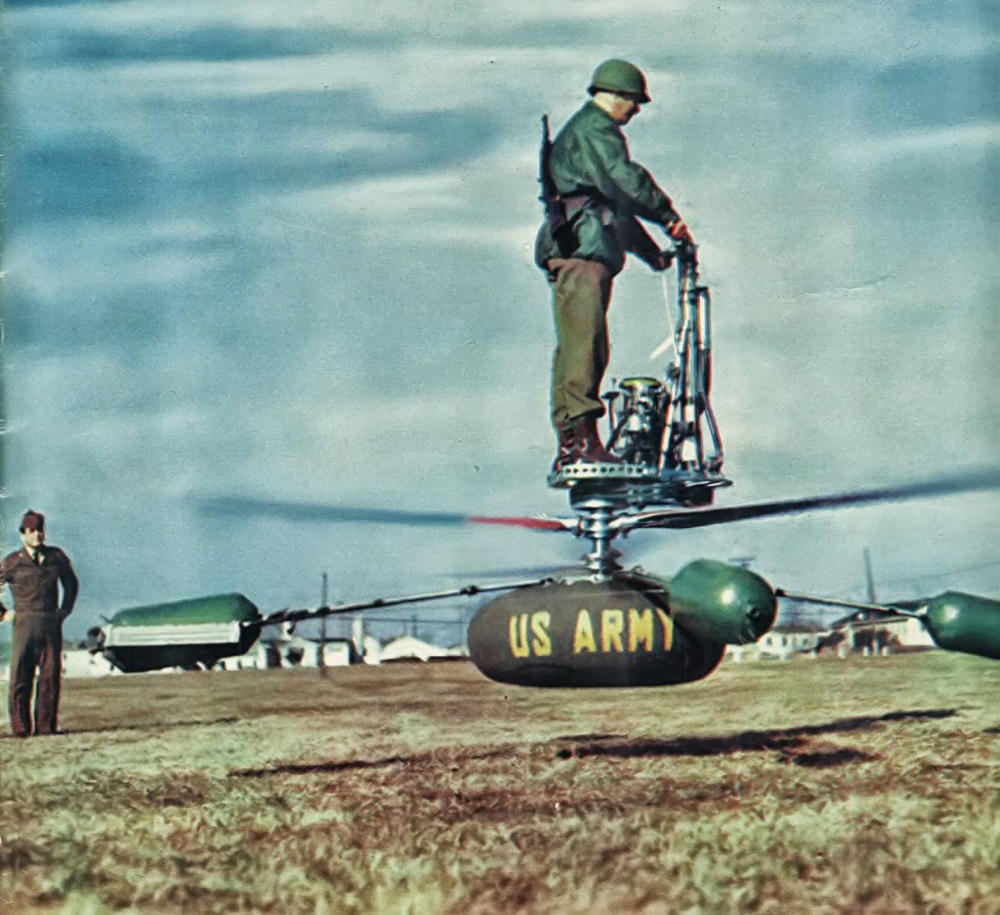
Balanced on a narrow platform above a spinning rotor, a helmeted soldier rides what looks less like an aircraft and more like a flying stand—an audacious attempt at a one-man personal helicopter. The bulbous float below, stenciled with “US ARMY,” anchors the scene in the era’s military experimentation, while the open framework and exposed mechanics reveal how little separated pilot from machine. Set against a wide, pale sky and a flat test field, the de Lackner HZ-1 Aerocycle feels both futuristic and precariously immediate.
Cold War imagination often chased mobility as much as firepower, and the Aerocycle promised a new kind of individual airlift: quick, portable, and simple enough to operate with minimal training. In the photo, the aircraft hovers close to the ground, its landing float and outrigger-like elements suggesting a design meant to stay upright even when handled roughly. Yet the very simplicity that made it appealing—standing upright with limited protection and relying on a compact rotor system—also hints at why flight testing could turn risky in a heartbeat.
For readers interested in 1950s inventions and experimental aviation, this image is a stark reminder that progress is rarely a smooth climb. The HZ-1 Aerocycle’s story is tied to the hard lessons learned in test programs, where stability, control, and safety could not be negotiated away for novelty. Long after the concept faded, the photograph endures as a vivid snapshot of a moment when the dream of personal vertical flight briefly hovered within reach—and then proved how difficult it was to make that dream practical.