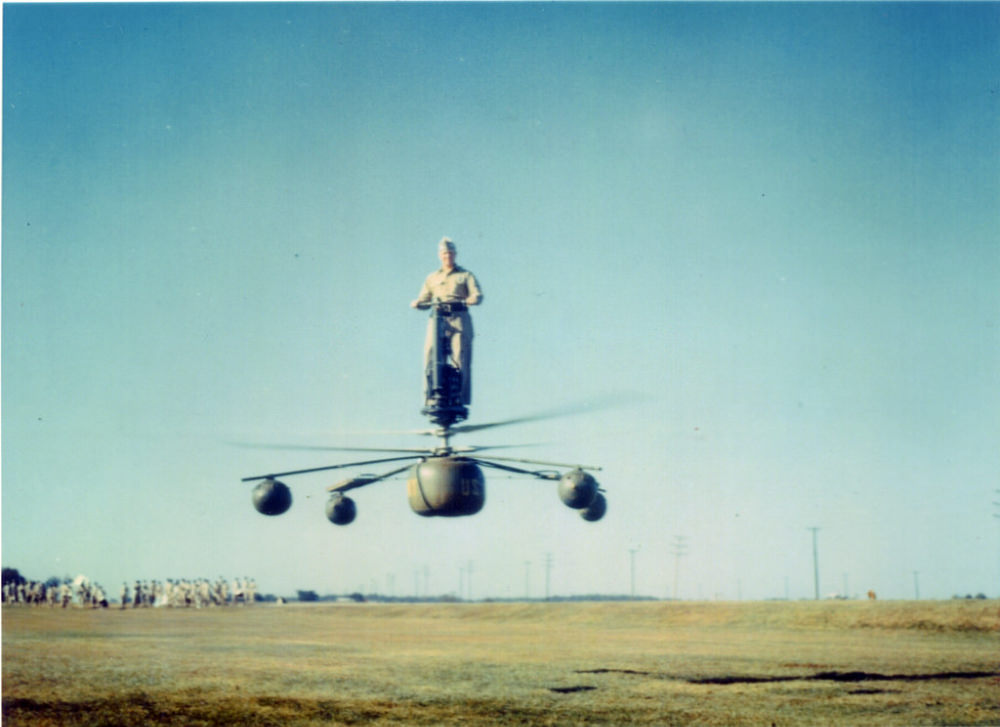
Suspended against a wide, cloudless sky, a lone test pilot stands upright on a spindly rotorcraft that looks less like a helicopter and more like a flying platform. The de Lackner HZ-1 Aerocycle was an audacious 1950s experiment in personal aviation, pairing a single main rotor with a minimal frame and bulb-like outriggers that hint at stabilizing floats or weights. In the foreground, the craft hovers low over a flat field while a small crowd gathers in the distance, turning the flight test into a public spectacle of futuristic engineering.
What makes the Aerocycle so striking is how much it asks of its rider: there’s no cockpit, no fuselage, and nowhere to hide from the wind or the machine’s vibrations. The pilot’s stance—hands on a simple control bar—suggests a device intended to be “ridden” rather than flown, like an airborne scooter meant for quick hops and tight landings. That stark simplicity is exactly what made the concept appealing on paper and unnerving in practice, especially as real-world handling exposed how unforgiving a one-man helicopter could be.
Failure, in this case, is part of the story rather than the end of it, and the photo captures the moment when invention meets its limits. The Aerocycle’s promise of easy, individual flight collided with stability challenges and safety concerns that couldn’t be solved by minimalism alone. For anyone interested in Cold War-era prototypes, experimental rotorcraft, or the history of personal helicopters, this image offers a vivid reminder that many breakthroughs are preceded by bold machines that didn’t quite work—but still changed the conversation about what flight might become.