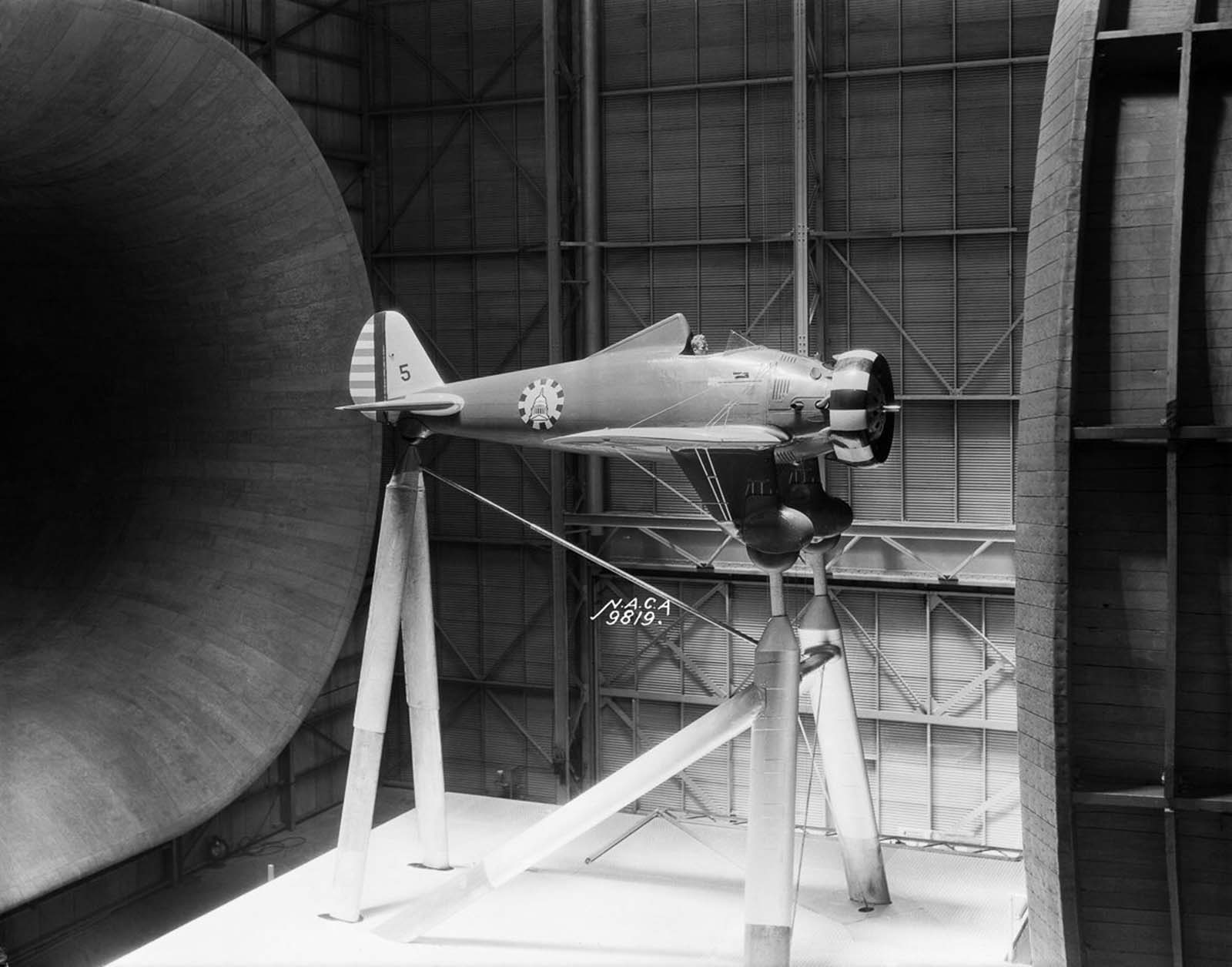
Suspended on a tall test stand, a Boeing P-26A fighter sits poised before the yawning mouth of the 30 × 60 Full Scale Tunnel, its compact fuselage and braced wings sharply outlined against the ribbed walls of the facility. The aircraft’s fixed landing gear and radial engine—features that instantly place it in the transitional era of aviation design—become the focal points when framed by the tunnel’s immense scale. Even at rest, the scene suggests motion, as if the next breath of air could turn the quiet hangar into a controlled storm.
Inside this kind of wind tunnel, engineers could study a real, full-size airplane under carefully measured airflow, chasing answers that flight alone couldn’t reliably provide. Struts, cables, and mounts hold the fighter steady while the tunnel does the work, helping reveal how air presses on wings, tugs at control surfaces, and swirls around the engine and landing gear. The stark geometry of beams and panels around the aircraft underscores the industrial precision behind aeronautical innovation.
For historians of technology, the photograph reads like a snapshot of invention in progress—where daring design met laboratory discipline long before modern computer simulations became routine. The Boeing P-26A’s distinctive silhouette, paired with the monumental “30 × 60” setting, makes this image a compelling artifact for anyone searching aviation history, NACA wind tunnel research, or early fighter aircraft development. It’s a reminder that breakthroughs often begin not in the sky, but in a cavernous room built to recreate it.