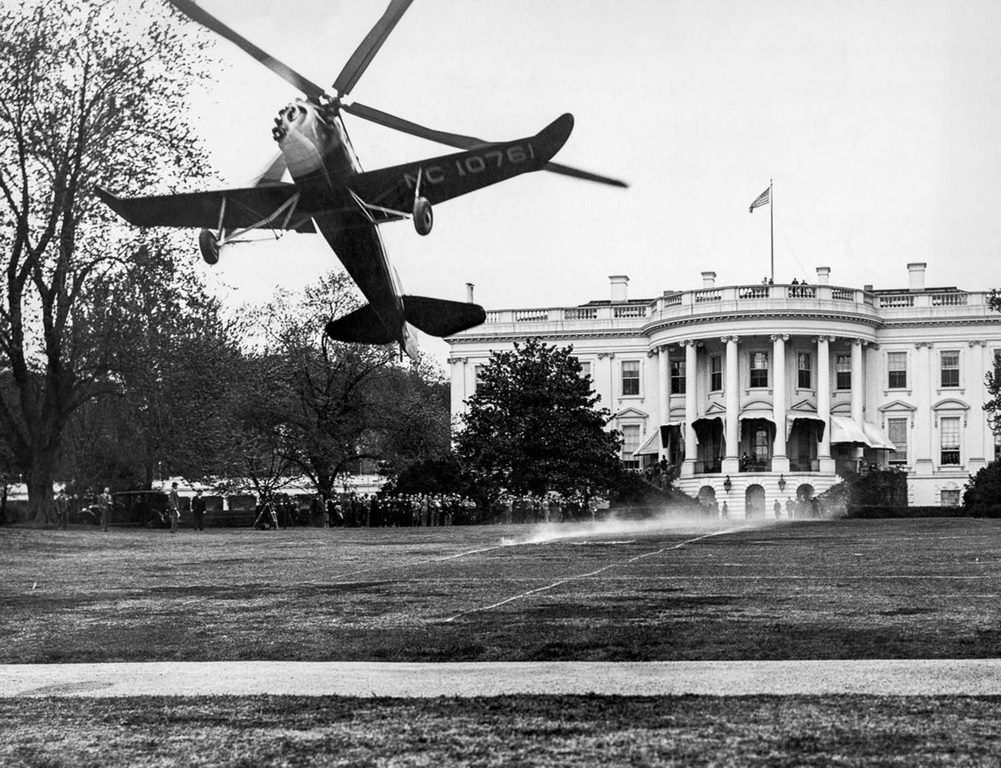
Rotor blades blur into a dark halo as an autogyro lifts off from the White House lawn, its compact airframe pitched upward in a clean, confident climb. The South Portico sits sharp in the background, columns and windows framing a moment when experimental aviation brushed against the most formal stage in American civic life. On the grass below, a pale streak of dust and disturbed turf traces the machine’s path as it transitions from rolling to airborne.
Unlike a conventional airplane, an autogyro relies on a free-spinning rotor for lift while a propeller provides forward thrust, a clever hybrid that promised shorter takeoffs and safer low-speed handling. The registration marking on the fuselage hints at the era’s growing culture of regulated flight, even as the technology itself still carried the thrill of novelty. Crowds gather along the edge of the grounds, a reminder that early flight demonstrations were public spectacles as much as engineering tests.
Set in 1931, the scene belongs to a time when inventions were celebrated as tangible signs of progress, and the boundaries between daring demonstration and practical transportation were still being negotiated. Placing an autogyro against the White House underscores how quickly aviation moved from distant airfields to the nation’s symbolic center. For readers searching for historical aviation photos, early rotorcraft, or White House history, this image offers a rare intersection of innovation, politics, and public curiosity.