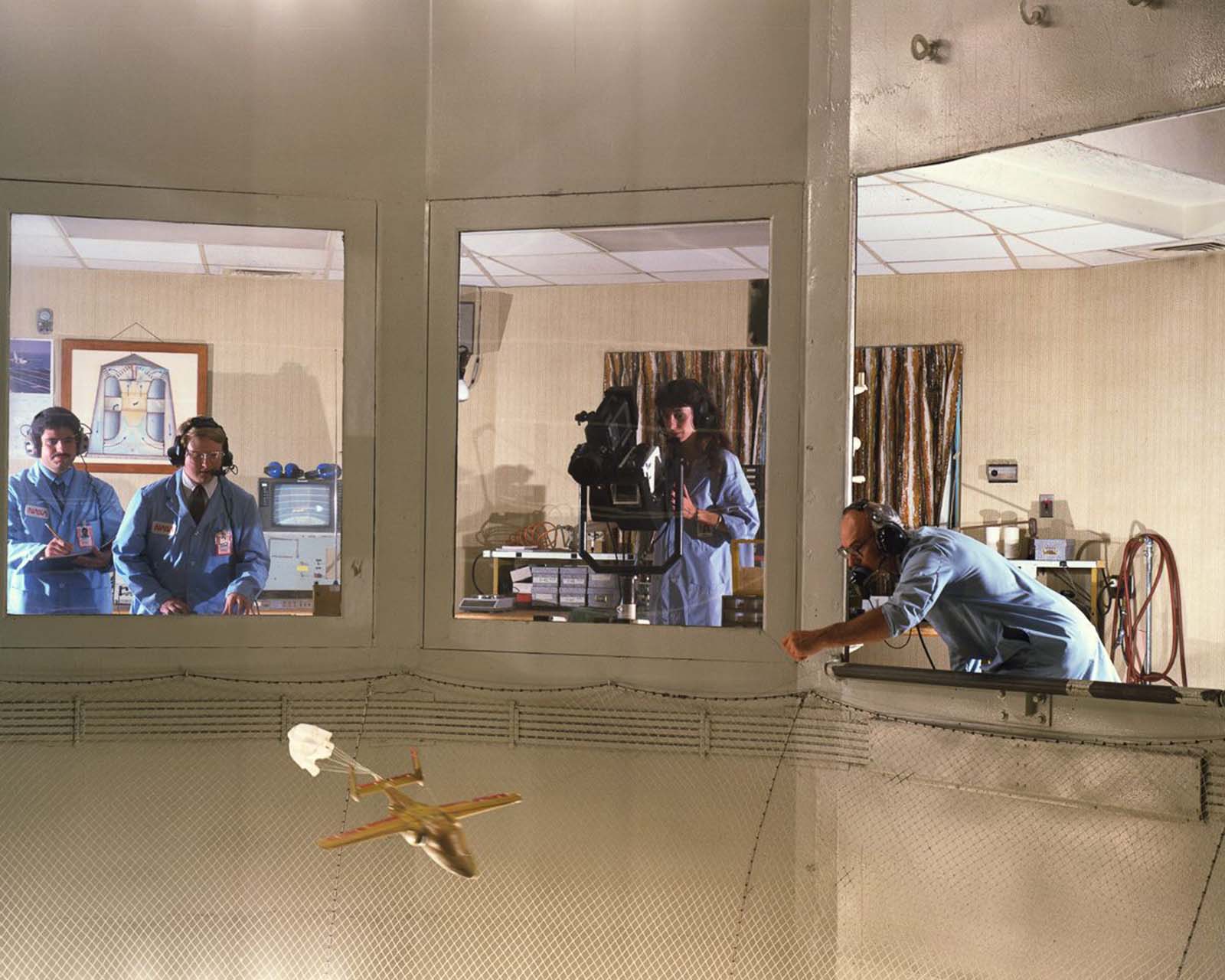
Behind three thick observation windows, a small aircraft model darts and tilts inside the Spin Tunnel while engineers in headsets track every twitch. The scene has the controlled intensity of a lab: clipboards ready, instrumentation glowing, and a protective mesh stretched across the chamber to catch the test article when the air turns unforgiving. Even at miniature scale, the model’s nose-down attitude and blurred motion hint at the violent, spiraling behavior researchers are trying to understand.
Spin tunnels were built to recreate the most dangerous corner of flight—stalls and spins—where an aircraft can lose lift and begin rotating in ways pilots struggle to counter. By forcing a model through repeatable patterns and measuring its response, aerodynamicists could compare design tweaks, evaluate stability, and refine recovery characteristics long before anything flew full-size. The 1987 setting places this work in an era when hands-on experimentation and early digital readouts often shared the same room, bridging classic wind-tunnel craft with increasingly data-driven analysis.
What makes the photograph memorable is its human scale: technicians leaning in close, watching with the patience of people who know that safety is built from thousands of small observations. The lab coats, cables, and quiet equipment underscore how “inventions” rarely arrive as sudden flashes, but as careful testing, documentation, and iteration. For readers interested in aviation history, aerospace engineering, or the evolution of wind tunnel research, this image offers a vivid glimpse of how flight was made safer—one spinning model at a time.