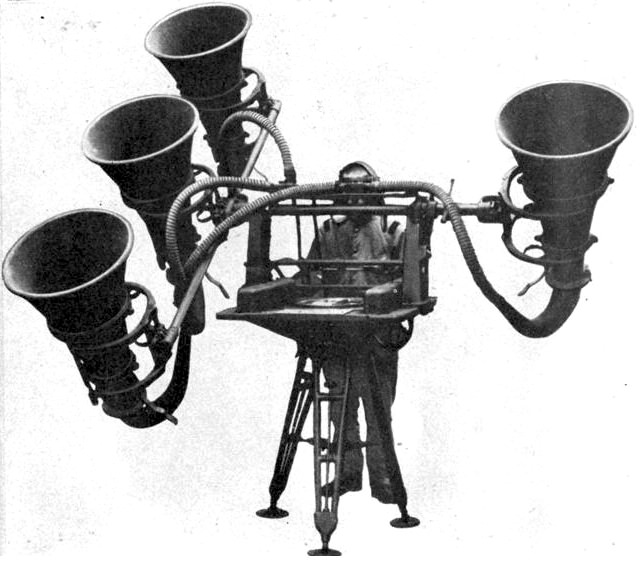
Four oversized horn-shaped receivers flare outward like metal flowers, all of them tethered by thick corrugated tubes to a rigid frame that surrounds the operator. The man stands at the center on a tripod-like base, head close to a small listening or viewing station, as if the entire contraption is meant to funnel the outside world into one concentrated point. Even without labels, the design reads as purposeful: a portable, human-guided detector built for capturing faint signals.
Seen through the lens of late-1930s invention culture, the apparatus belongs to that fascinating moment when engineers pushed mechanical solutions to the edge of their possibilities. Before compact electronics became dominant, detection often meant amplifying nature with geometry—big horns to gather sound, careful angles to pinpoint direction, and sturdy frames to keep everything aligned. The result is both intimidating and elegant, a reminder that “high tech” once looked like sculpted steel and rivets rather than circuits.
For readers interested in Japanese technology history, early detection devices, and pre-radar sensing equipment, this photo offers a striking snapshot of experimentation and urgency. It also makes a compelling WordPress feature for posts about forgotten inventions: the blend of human posture and machine architecture tells its own story, inviting questions about how it was used, what it could hear, and what challenges shaped its form. The late 1930s context adds extra weight, positioning this detector within a world rapidly learning to measure, locate, and react.