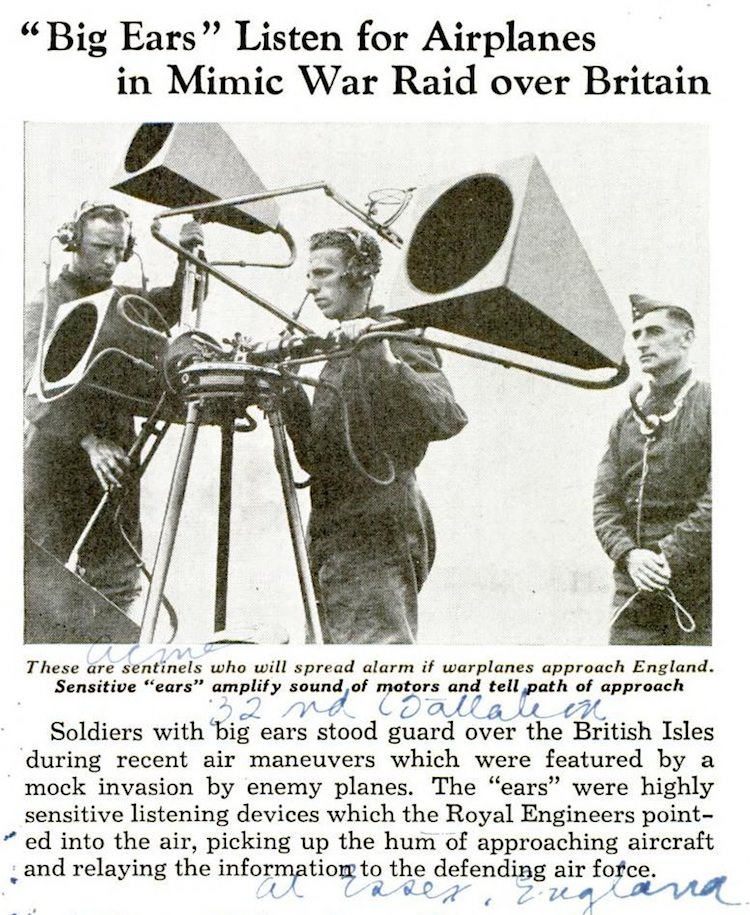
Long before radar became the watchman of the skies, defenders relied on sound, patience, and contraptions that look almost theatrical today. In “Big Ears” Listen for Airplanes, 1938, uniformed sentinels cluster around a tall tripod supporting oversized horn-like collectors, their faces set in concentration as they angle the apparatus toward the open air. The headline’s language—part warning, part wonder—frames the scene as a practical experiment in early air defense, when hearing an engine first could mean precious minutes gained.
At the heart of the photograph is the listening device itself: large acoustic “ears” designed to amplify distant aircraft noise and help determine an approaching direction. The men appear to work as a team, with one monitoring and adjusting while another stands ready, suggesting a coordinated drill rather than a casual demonstration. The printed caption beneath reinforces the purpose—detecting warplanes by motor hum and relaying information—making this a striking glimpse into the transitional technology of the late 1930s.
Between invention and anxiety, the image captures a moment when modern warfare pressed innovation into everyday service, even if the tools still seemed rooted in the physics of megaphones and funnels. For readers interested in military history, early warning systems, and interwar engineering, this photo illustrates how ingenuity filled the gaps before electronic detection dominated. It’s also a reminder that the road to sophisticated aviation surveillance was built from experiments like these—part science, part improvisation, and entirely shaped by the looming threat overhead.