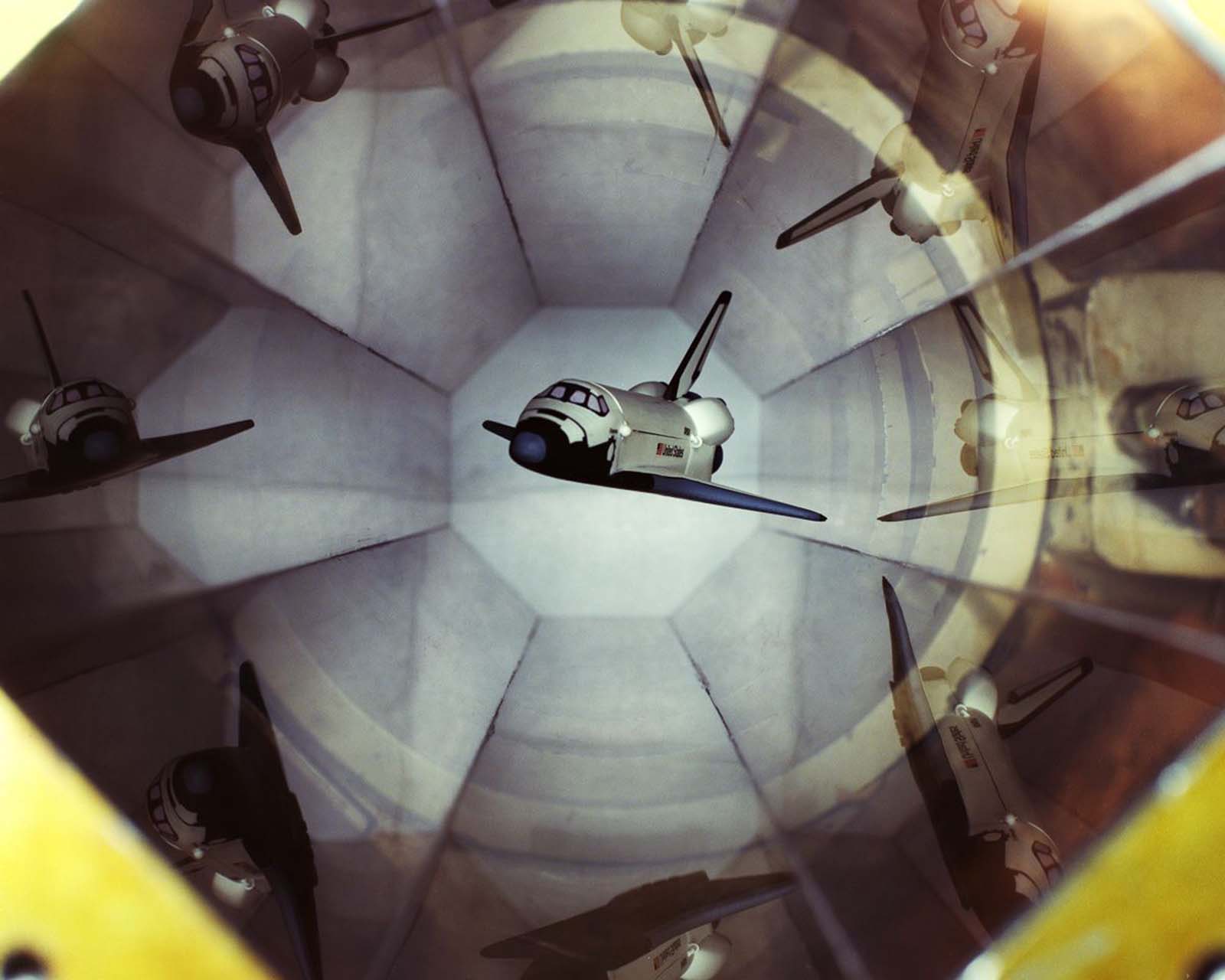
Floating in the center of a transparent, hexagonal test section, a small shuttle orbiter model appears to hover with uncanny steadiness, its nose pointed into an invisible stream. The chamber’s faceted walls and the soft reflections around the edges give the scene a geometric, almost cathedral-like depth, emphasizing just how controlled—and how precise—this kind of laboratory environment must be.
Magnetic suspension and balance systems like the MIT/NASA Langley 6 inch MSBS were built to solve a stubborn problem in aerodynamics testing: the very supports used to hold a model can disturb the airflow you’re trying to measure. By suspending the shuttle model without physical struts, engineers could study forces and moments more cleanly, capturing subtleties of lift, drag, and stability that matter when designing vehicles meant to travel from atmosphere to space and back again.
Viewed today, the photo reads as a compact history of invention: a marriage of university research and NASA wind-tunnel expertise, translated into a deceptively simple visual—an orbiter seemingly held by nothing at all. For readers interested in aerospace engineering history, wind tunnel testing, or the technologies that shaped the Space Shuttle era, this image offers a vivid reminder that breakthroughs often happen in quiet rooms filled with clear panels, careful instrumentation, and a model that must be kept perfectly still.