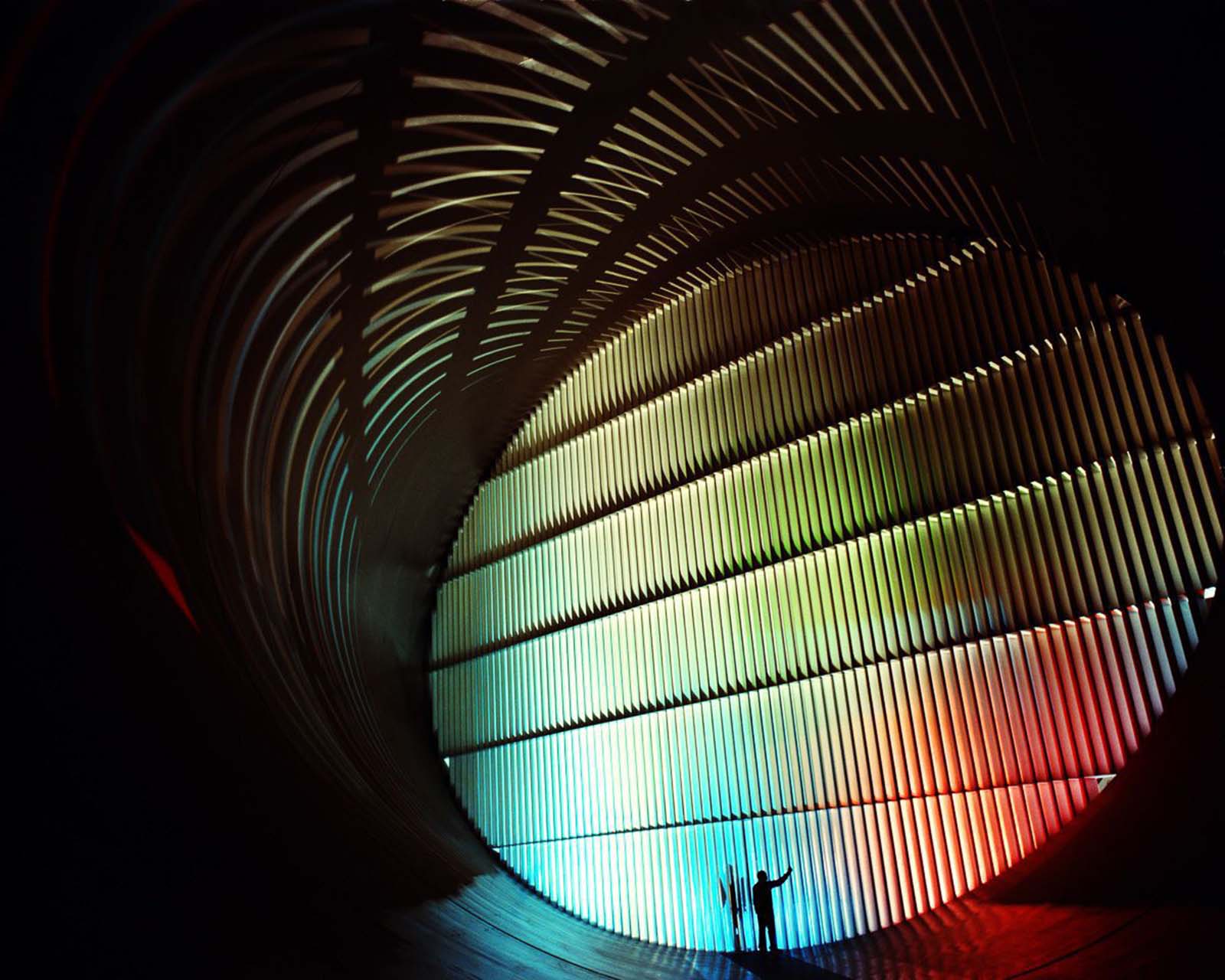
Curving ribs of metal draw the eye down the throat of the 16-Foot Tunnel at Langley, where rows of turning vanes form a precise, almost architectural spiral. The lighting washes across the blades in bands of cool and warm color, turning a piece of aerodynamic hardware into something that feels both industrial and luminous. Even without seeing the machinery behind it, the scene suggests controlled force—air guided, shaped, and disciplined by design.
Turning vanes are the quiet workhorses of wind tunnel engineering, installed to straighten and steer flow as it rounds corners and accelerates toward the test section. In a facility like Langley’s, those thin, evenly spaced elements help create the smooth, predictable airflow needed for trustworthy measurements—an essential ingredient in research on aircraft performance and other high-speed aerodynamics. The 1990 context places this image in an era when large-scale wind tunnel testing remained a cornerstone of invention, complementing the growing role of computer simulation.
Near the bottom of the frame, a lone figure stands dwarfed by the structure, offering an instant sense of the tunnel’s monumental scale and the human effort behind the science. That contrast—small silhouette against vast engineering—anchors the photograph as more than technical documentation; it’s a visual story about experimentation, infrastructure, and the craft of making air behave. For readers interested in aerospace history, wind tunnel technology, or the evolution of research tools, this moment inside Langley’s 16-Foot Tunnel is a striking reminder that innovation often begins in places built to be unseen.