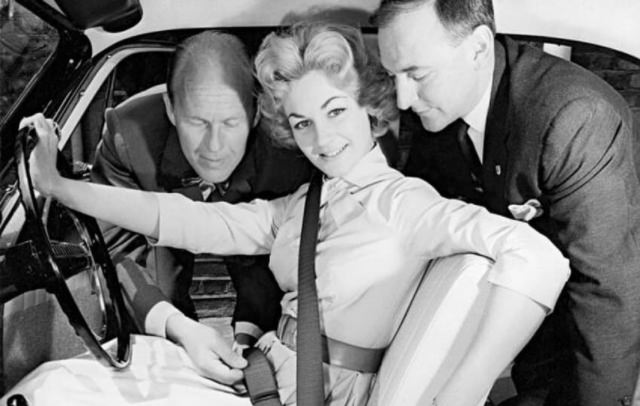
Inside a car’s front seat, a woman is posed with a diagonal strap crossing her chest while two suited men lean in to inspect and adjust the restraint, turning a simple cabin into a small stage for a big idea. The V-shaped geometry suggested by the title is easy to read in the way the belt anchors low and sweeps up toward the shoulder, keeping the torso from pitching forward. Details like the formal clothing and close, hands-on demonstration hint at an era when automotive safety still had to be explained, tested, and sold to the public one occupant at a time.
Volvo’s three-point safety belt stands out in this scene not as an accessory, but as an invention meant to become routine—something drivers would buckle without a second thought. The photograph emphasizes fit and placement: where the belt sits on the body, how it lies flat, and how it distributes force across stronger parts of the frame. That quiet practicality is exactly what made the three-point seat belt one of the most influential car safety innovations ever introduced.
Few inventions can claim a legacy measured in everyday journeys rather than laboratory results, yet the title’s “saved one million lives” captures the scale of change that followed widespread adoption. The people in the car look focused and calm, as if rehearsing the future of road travel—one in which protection is built into the act of driving. For readers searching the history of the Volvo seat belt, the origins of the three-point restraint, or the story behind life-saving automotive inventions, this image offers a vivid reminder that the modern seat belt began as a carefully demonstrated breakthrough.