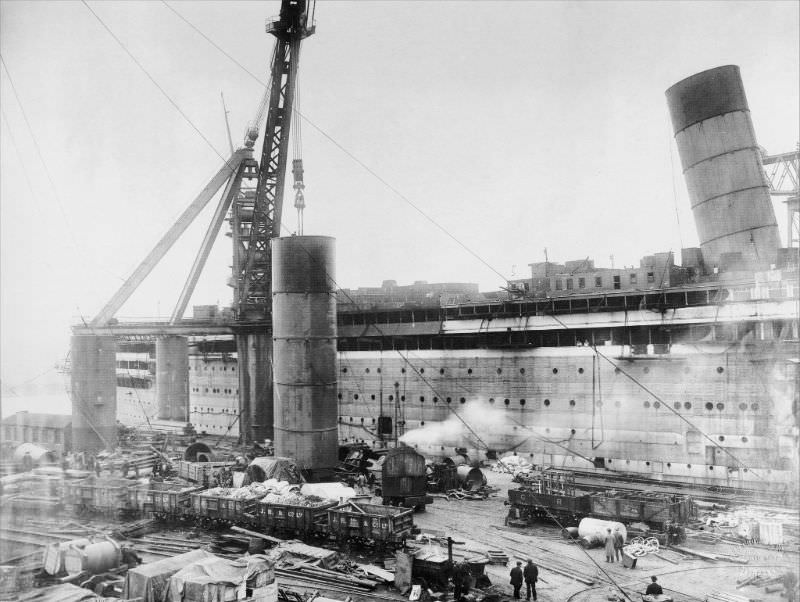
Steelwork and rigging dominate the shipyard scene as one of RMS Aquitania’s enormous funnels waits to be lifted into place during fitting-out around 1913. A tall crane looms beside the liner’s flank, its cables poised over the cylindrical structure, while the hull’s rows of portholes and long bands of plating hint at the scale of the vessel taking shape. The partially completed superstructure stretches across the frame, making the funnel feel less like an accessory and more like a defining landmark of the ship’s silhouette.
Down on the ground, the clutter of rail wagons, stacked materials, and scattered equipment speaks to the logistical choreography behind ocean liner construction. The yard looks busy even in stillness—smoke or steam drifts near the work area, and small figures at the bottom edge emphasize the human labor required to assemble components that tower overhead. Details like the second funnel already standing on the right suggest the step-by-step progress of turning a bare hull into a finished passenger liner.
For readers interested in maritime history, early 20th-century engineering, and the era of great transatlantic ships, this moment offers a vivid glimpse of industrial “inventions” in practice: heavy lifting, modular construction, and precision fitting on a grand scale. Aquitania’s funnel installation wasn’t just a visual milestone; it marked the integration of the liner’s ventilation and exhaust systems into the final profile seen in period postcards and news coverage. As a WordPress feature image or archival post, it pairs rich shipyard detail with the drama of a major component about to take its place high above the deck.