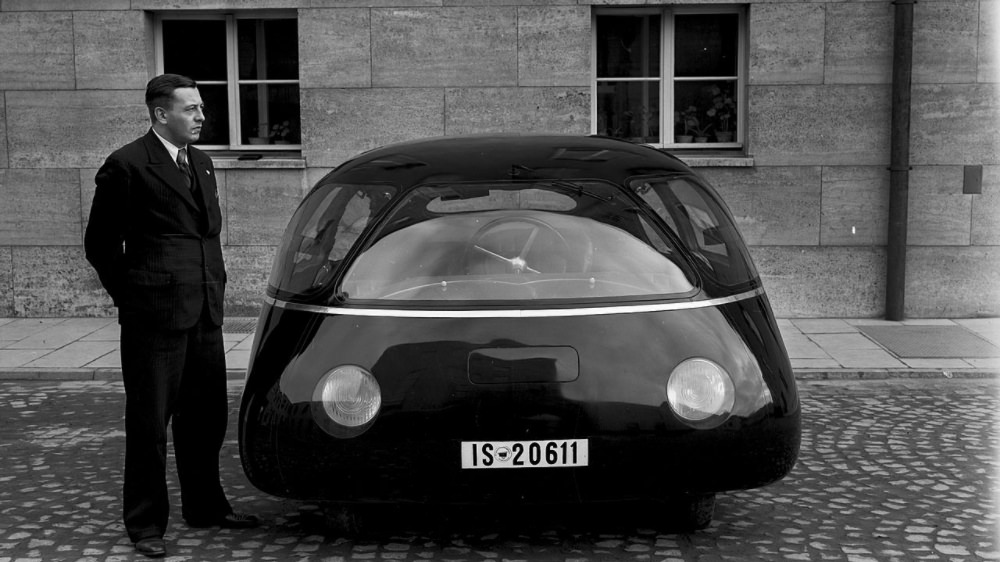
Parked against a plain stone façade, the Schlörwagen looks less like a conventional automobile and more like a rolling experiment in airflow. Its bulbous, teardrop body and glassy canopy swallow the front end in a single smooth curve, while the headlights sit like portholes on a sealed shell. A suited observer stands beside it for scale, underscoring just how wide and unconventional this ultra-aerodynamic German car really was.
What makes the 1939 Schlörwagen so fascinating is the way it embodies the interwar obsession with streamlining—an era when engineers chased speed and efficiency by shaping vehicles like aircraft fuselages. The smooth nose, minimal protrusions, and rounded roofline all point to a design philosophy aimed at reducing drag, even if it meant sacrificing the familiar cues that made cars look “normal.” In this photograph, the vehicle’s strange beauty feels intentional: a prototype meant to provoke questions as much as it promised performance.
Yet for all its forward-thinking engineering, the Schlörwagen remains a famous automotive dead end—an invention that never became a production reality. That tension is the story the image quietly tells: radical design meeting practical constraints, public perception, and the shifting priorities of a world on the brink. For readers interested in forgotten prototypes, aerodynamic history, and rare German inventions, this is a compelling glimpse of a future that almost was.