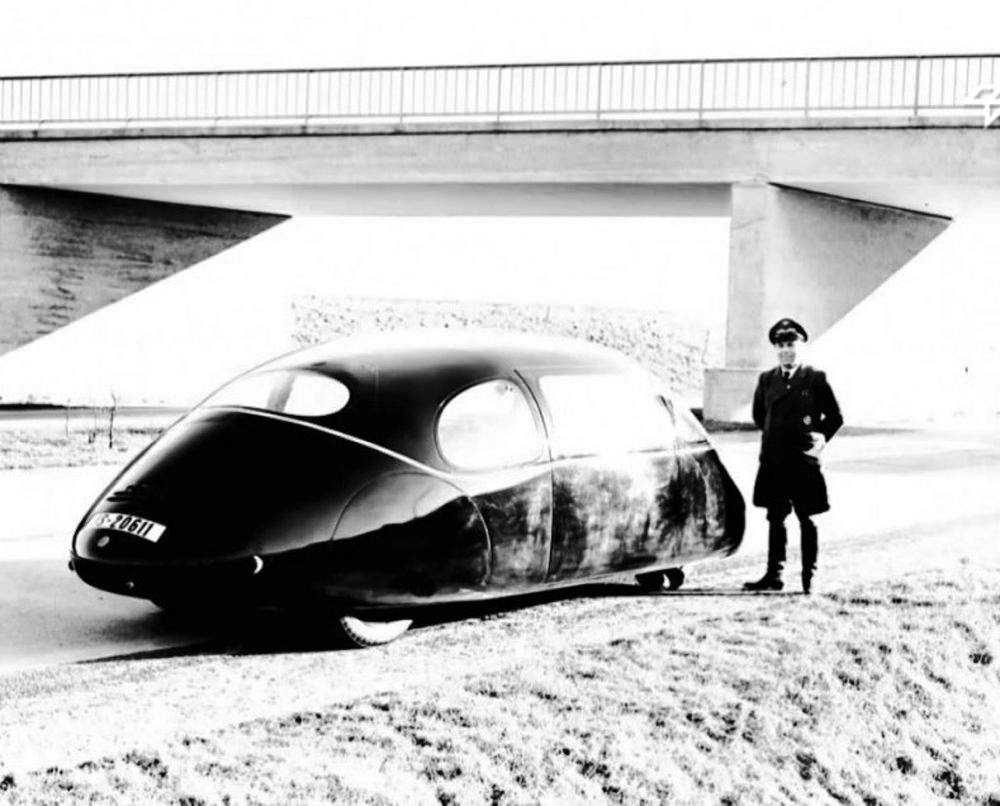
Parked beneath a stark concrete overpass, the Schlörwagen looks less like a conventional automobile than a polished teardrop that has rolled off an engineer’s drawing board and into the real world. Its smooth, uninterrupted bodywork swells outward to cover the wheels, while small oval windows punctuate the dark shell like portholes on a futuristic vessel. A uniformed figure standing beside it provides scale, emphasizing just how long and low this ultra-aerodynamic German car concept appears.
Built around the idea that air resistance was the true enemy of speed and efficiency, the 1939 Schlörwagen embodies the interwar obsession with streamlining in everything from trains to household appliances. Even in a still photograph you can sense the experiment: minimal frontal clutter, tapered rear, and an almost aircraft-like pursuit of reduced drag. Details such as the enclosed wheel arches and the rounded tail hint at a prototype meant for testing and demonstration rather than everyday traffic.
Yet for all its bold innovation, this bizarre invention never became a mainstream vehicle, and that tension is what makes the image so compelling for automotive history. The Schlörwagen stands as a reminder that progress often arrives through dead ends—ideas that were technically fascinating but impractical, expensive, or simply too strange for the road. For readers searching the story behind the Schlörwagen car, this photo offers a rare glimpse of a future that briefly appeared in 1939 and then slipped away.