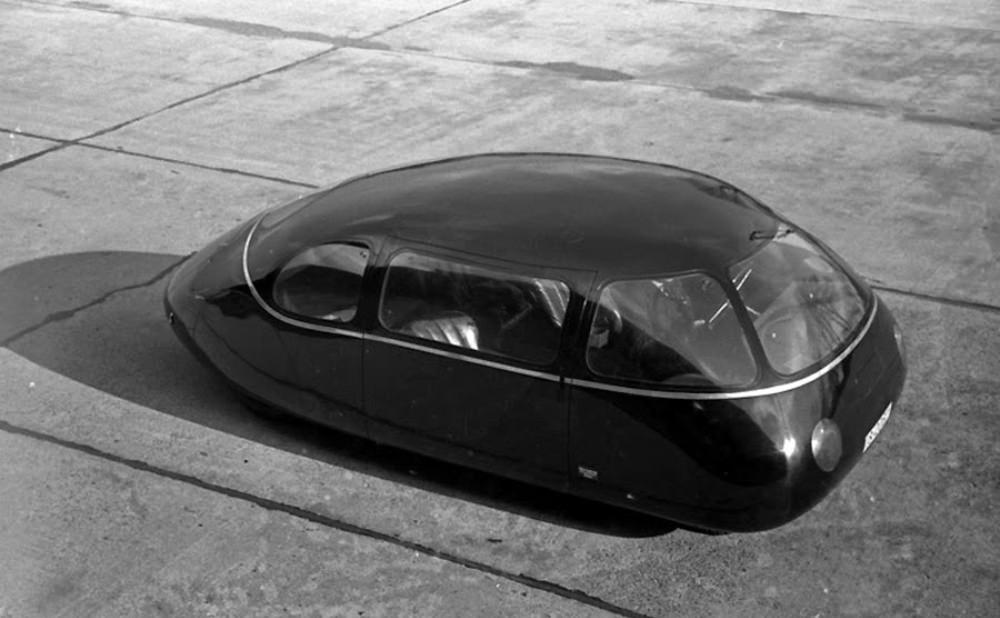
Sleek like a dropped teardrop and oddly low to the ground, the 1939 Schlörwagen looks less like a conventional automobile than a rolling experiment in airflow. Its bulbous canopy and smooth, uninterrupted curves dominate the frame, with broad windows that wrap around the body and leave barely any sharp edge for the wind to catch. Even at rest on the wide pavement, the car seems designed for motion—an ultra-aerodynamic German concept that pursued efficiency with a near-scientific single-mindedness.
What makes this invention so fascinating is how boldly it rejects the familiar “engine up front, boxy cabin behind” silhouette of its era. The streamlined shell suggests a vehicle shaped first in the mind of an aerodynamicist, where drag reduction mattered as much as comfort or style, and where the entire body becomes a kind of fuselage for the road. Details like the long side glazing and the rounded rear underscore the intent: to slice through air cleanly, promising quieter travel and better fuel economy long before such goals became mainstream talking points.
Yet the Schlörwagen also stands as a reminder that the most advanced ideas don’t always win a place in everyday life. Radical designs can be difficult to manufacture, hard to maintain, and even harder to sell to drivers who expect a car to look like a car. Seen today in this historical photo, it reads as a captivating “what if” from the late 1930s—an invention that hinted at the future, then slipped into the margins of automotive history.