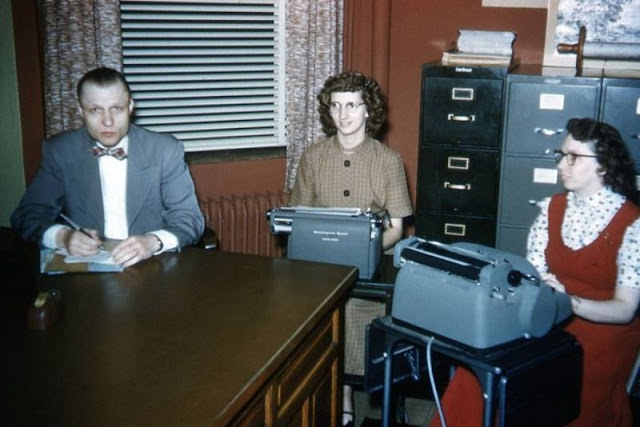
Office life comes into focus with two women positioned at their typewriters while a man sits at a wooden desk, papers laid out as if a meeting has just begun. The machines in the foreground and center are sturdy mid-century workhorses, designed for speed and repetition, and their presence anchors the scene in the everyday world of clerical labor. Behind them, metal filing cabinets and a shaded window hint at the quiet infrastructure that kept businesses, schools, and public offices running smoothly.
What stands out is the sense of routine professionalism: upright posture, attentive expressions, and hands close to the keys, ready to turn spoken words into clean lines of text. Typewriters were among the most influential past inventions in the modern office, transforming correspondence, record-keeping, and the pace of decision-making long before word processors arrived. For many women, typing skills opened doors to steady employment and a growing role in administrative work, even as the workplace remained shaped by formal hierarchies.
Color details add warmth to the period atmosphere, from the practical dresses and cardigans to the muted tones of institutional furniture. There’s a tactile quality to this moment—paper, ribbon, keys, and the inevitable clack that once defined productivity—making it easy to imagine memos being drafted and reports being filed away. For readers searching historical photos of ladies using typewriters, this image offers a grounded glimpse of how technology and labor intersected in the era when the typewriter reigned supreme.