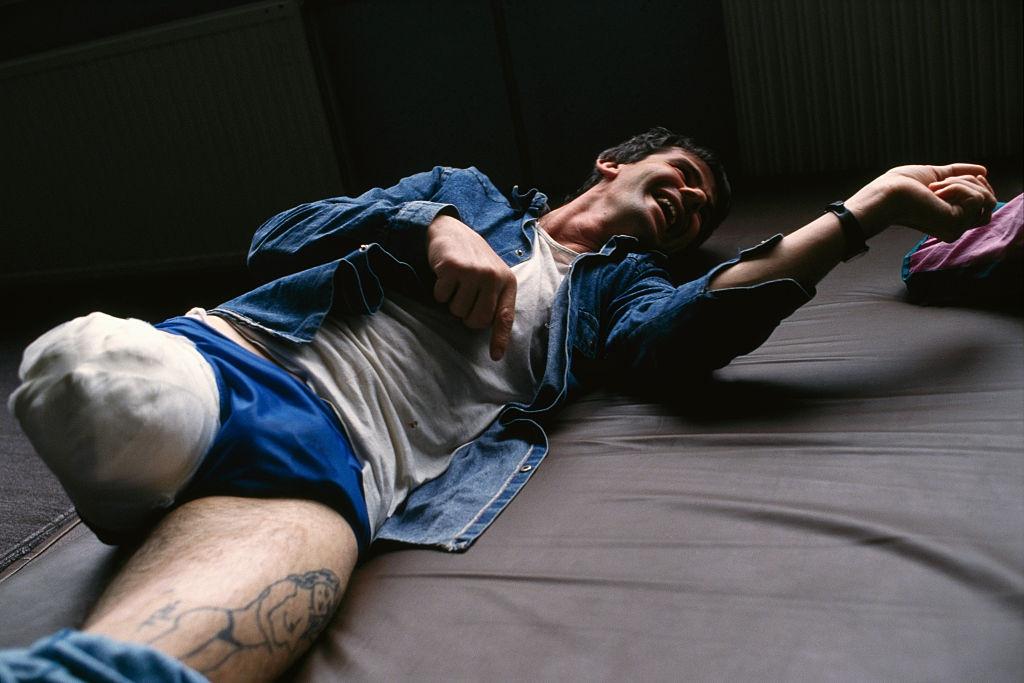
A man sprawls across a hospital mattress, one leg ending in a thick white bandage where an amputation has recently been performed. His denim shirt hangs open over a T‑shirt, and the angle of his body—one arm flung outward, the other drawn in tight—suggests both exhaustion and the strain of pain managed moment by moment. In the dim interior, the scene feels intimate and unguarded, the kind of quiet aftermath that follows violence rather than the violence itself.
Set against the siege of Sarajevo during the Yugoslav civil war, the photograph turns the conflict’s vast headlines into a single, human scale of loss. The patient is a civilian, not a soldier in a trench, and that distinction matters: it speaks to how urban warfare collapses the distance between front lines and everyday life. The stark contrast between ordinary clothing and extraordinary injury underscores how abruptly routine can be replaced by survival, surgery, and recovery.
For readers searching for historical images of the Bosnian War and the siege of Sarajevo, this frame offers a sobering look at wartime medicine and the long road that begins after the operating room. There is no spectacle here—only bandages, a bare mattress, and a person forced to adapt to a new body in the midst of an unfinished crisis. Photographs like this endure because they ask us to remember the cost of civil wars in the lives that continue afterward, measured not in territory but in limbs, sleep, and uncertain futures.