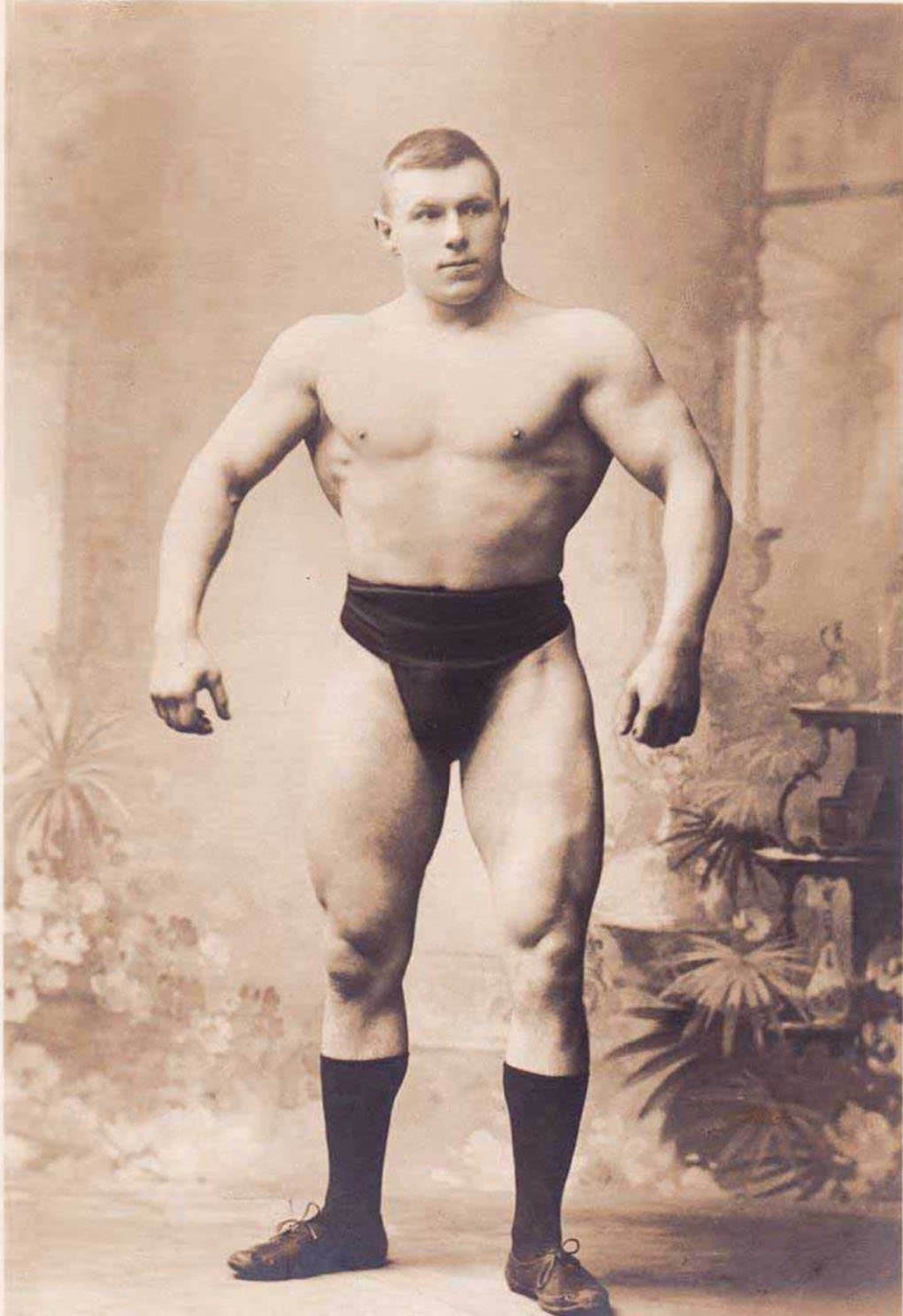
Standing squarely before a softly painted studio backdrop, Hackenschmidt is presented as both athlete and spectacle, his broad shoulders and powerful legs framed by the simple, practical kit of the era—dark trunks, high socks, and laced shoes. The pose is direct and unadorned, inviting the viewer to study symmetry, density, and control rather than pageantry. Even in this quiet setting, the photograph carries the energy of early strength culture, when physical development was becoming a modern fascination.
Around circa 1905, images like this circulated as proof of what disciplined training could achieve, bridging the worlds of sport, wrestling, and the emerging ideal of the “modern” bodybuilder. Hackenschmidt’s physique reads as functional mass—built for grappling and endurance as much as for display—suggesting a time before specialized competition categories and glossy fitness marketing. The sepia tone and studio props remind us that athletic celebrity was already being carefully staged for public consumption.
For readers exploring the history of bodybuilding and early 20th-century athletics, this portrait offers a compelling snapshot of changing attitudes toward strength, masculinity, and performance. It also highlights the role photography played in making sporting icons legible to audiences far beyond the arena. Filed under Sports, “Hackenschmidt, circa. 1905.” remains a striking reference point for anyone tracing the roots of modern physical culture.