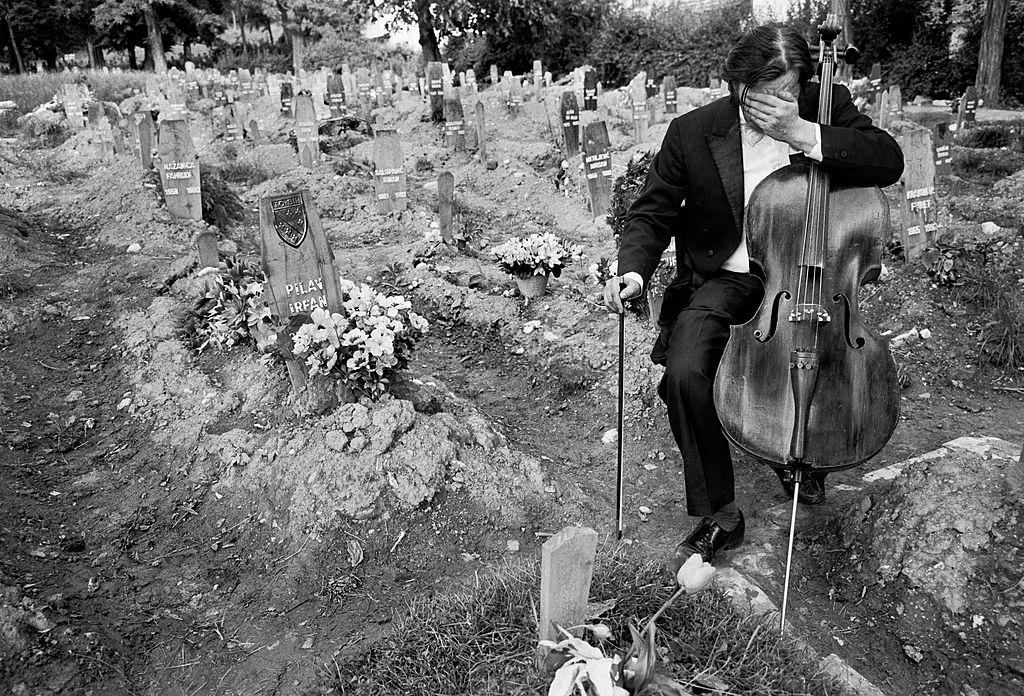
Graves stretch across Hero’s Cemetery in Sarajevo, their simple markers and scattered flowers forming a raw landscape of loss during the Bosnian War. In the foreground, cellist Vedran Smalovic sits with his instrument held close, his bow lowered, one hand covering his face as grief overtakes him. The scene is stark and intimate, turning a public burial ground into a quiet chamber for mourning.
The title’s story—Smalovic breaking down in tears after playing a requiem to a dead friend—adds a devastating clarity to what the camera freezes in time. The cello, normally associated with concert halls and composure, becomes a witness to the siege of Sarajevo and the funerals of fighters laid to rest here. Even without sound, the photograph suggests a requiem carried by breath, trembling hands, and the heavy pause after the last note.
For readers searching for images of civil wars, Sarajevo 1992, and the human cost of the Bosnian conflict, this photograph offers more than documentation; it offers a moral atmosphere. It reminds us how music can serve as protest, prayer, and companionship when ordinary life has been shattered. In one frame, remembrance, resilience, and private sorrow meet among the graves, refusing to let the dead become anonymous.