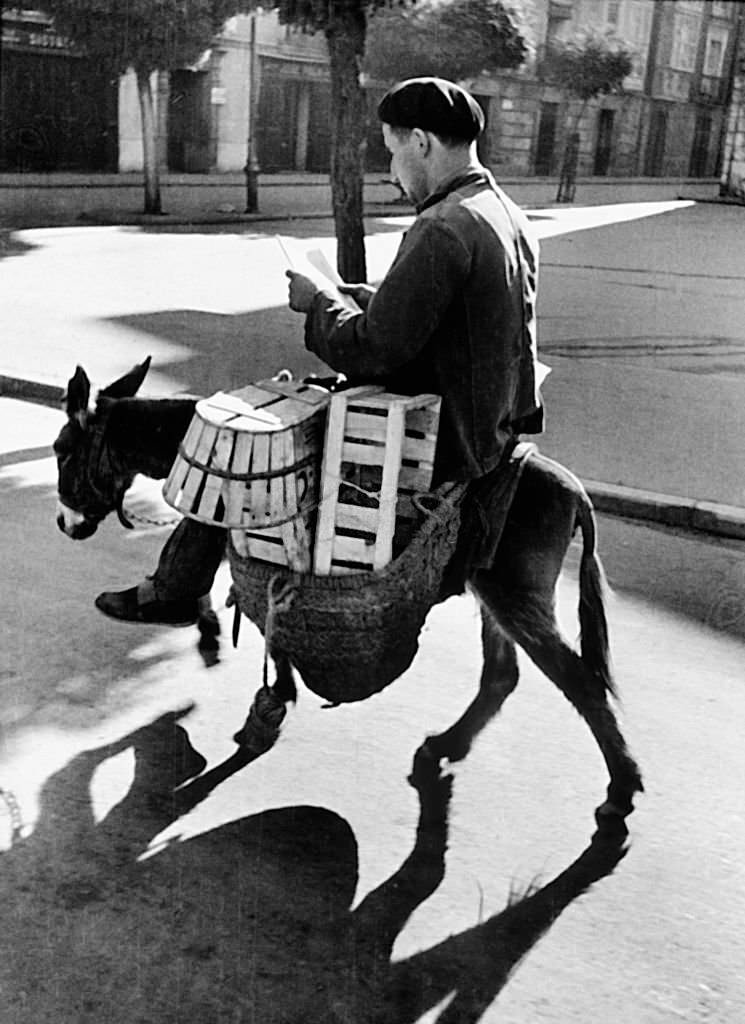
A quiet absurdity rides through the frame: a man perched on a donkey, absorbed in a book as if the street were his private study. The animal’s steady gait, the rider’s focused posture, and the long, sharp shadows on the pavement create a scene that feels both everyday and strangely suspended in time. In the background, a broad road and formal building façades hint at an urban setting, while the donkey’s simple tack and the rider’s plain clothing keep the moment grounded in lived reality.
Erich Andres photographed this during the Spanish Civil War in 1939, and that context lends the image its deeper charge. Wars are often remembered through explosions, uniforms, and crowds; here the drama is interior, suggested by a reader’s determination to keep hold of thought and routine. The donkey, burdened with strapped-on containers and a crate-like frame, evokes shortages and improvisation, the kind of practical adaptation that becomes second nature when normal life is disrupted.
For a WordPress post exploring Spanish Civil War photography, this picture works as an unforgettable emblem of resilience and the persistence of culture amid crisis. It invites viewers to linger over small details—the angle of the man’s hands on the pages, the animal’s ears turned forward, the sunlight that flattens the street into a stage—and to imagine how literacy and curiosity traveled alongside necessity. In a single candid moment, Andres offers a human-scale history: not the clash of armies, but the stubborn continuation of daily life.