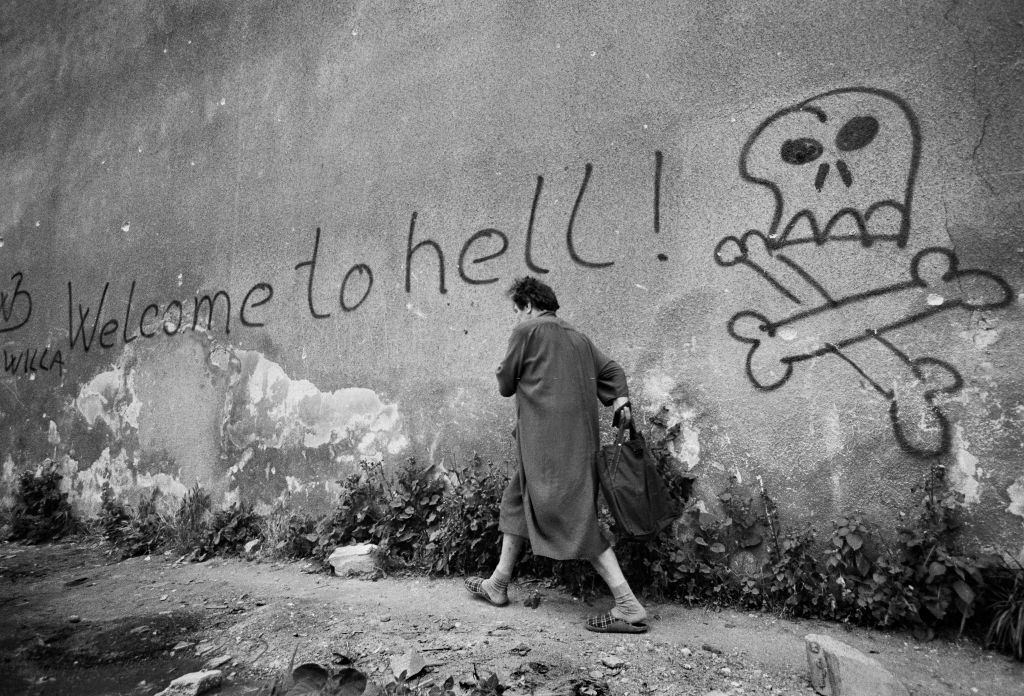
Across a scarred wall, the words “Welcome to hell!” stretch in hurried graffiti beside a crude skull-and-crossbones, turning a city street into a warning sign. A lone woman moves quickly along the edge of the pavement, head bowed, clutching a bag as if speed and silence might offer the only protection. The rough ground, crumbling plaster, and invasive weeds at the wall’s base speak to a normal urban rhythm broken by siege.
Known as “Sniper Alley,” Sarajevo’s main thoroughfare became a corridor of calculated danger in 1992, where simply crossing open space could invite a shot. The photograph holds its tension in small details: her angled stride, the careful distance from the exposed street, the way public messages replace official signs when institutions fail. In a civil war, walls become newspapers, and a few words of paint can summarize an entire atmosphere of fear.
For readers searching the history of the Siege of Sarajevo, this scene distills the civilian experience into one fleeting passage—ordinary errands performed under extraordinary threat. The graffitied taunt doesn’t just describe a place; it records a mindset, a bitter humor used to survive when daily life is governed by uncertainty. As a historical photo, it reminds us how conflict marks not only buildings and roads, but also the body language of those forced to navigate them.