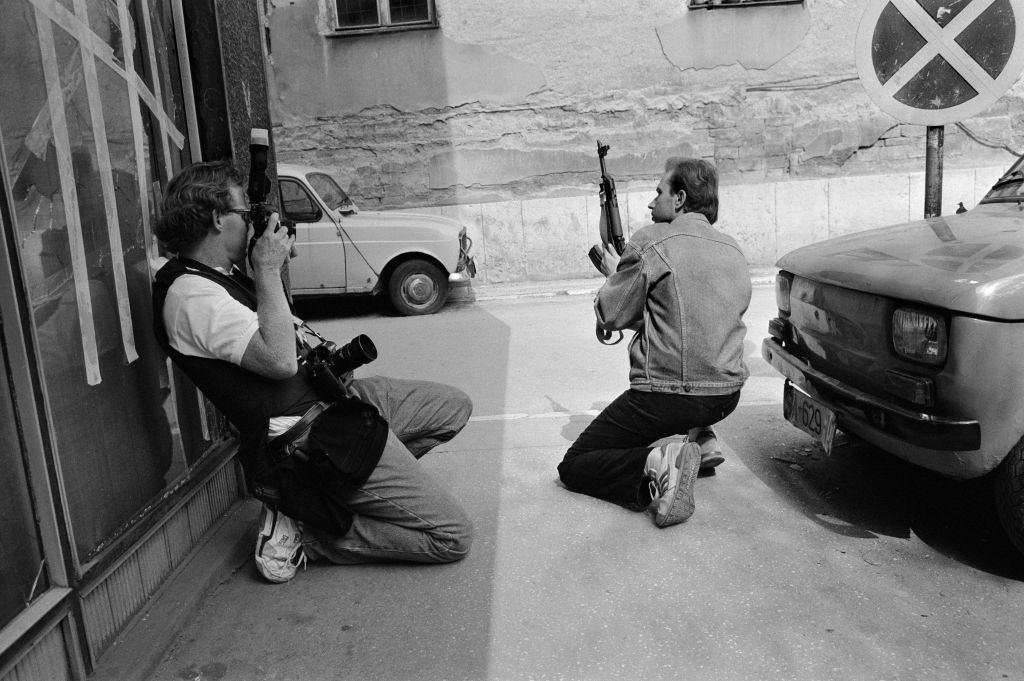
Against a rough, cracked wall and the hard edge of a curb, a photographer crouches low with his camera raised while an armed man kneels nearby, rifle angled toward a danger that sits just outside the frame. Parked cars and a street sign become makeshift cover, turning an ordinary urban corner into a thin line between exposure and survival. In that compressed space, David Turnley’s lens meets the urgency of street fighting during the siege of Sarajevo, capturing how quickly civilian streets can be repurposed by civil war.
Tension gathers in the small details: the photographer’s second camera hanging ready, the fighter’s posture braced on one knee, the street’s emptiness suggesting movement has been forced underground. The built environment—windows above, peeling plaster, the tight corridor between vehicles—reads like a battlefield map drawn by circumstance rather than strategy. For viewers searching for Sarajevo 1992 war photography or images of the Bosnian conflict, the scene communicates the siege’s defining reality: combat unfolding at street level, measured in seconds and meters.
What lingers is the uneasy partnership of witness and participant, both men pressed into the same vulnerable geometry of cover and risk. Turnley’s presence reminds us that documenting a civil war is itself a physical act, undertaken in the same spaces where people fight, flee, and endure. As a historical record, the photograph speaks to Sarajevo under siege not through grand vistas, but through a close, human-scale moment where the city’s everyday life has been interrupted and rewritten by violence.