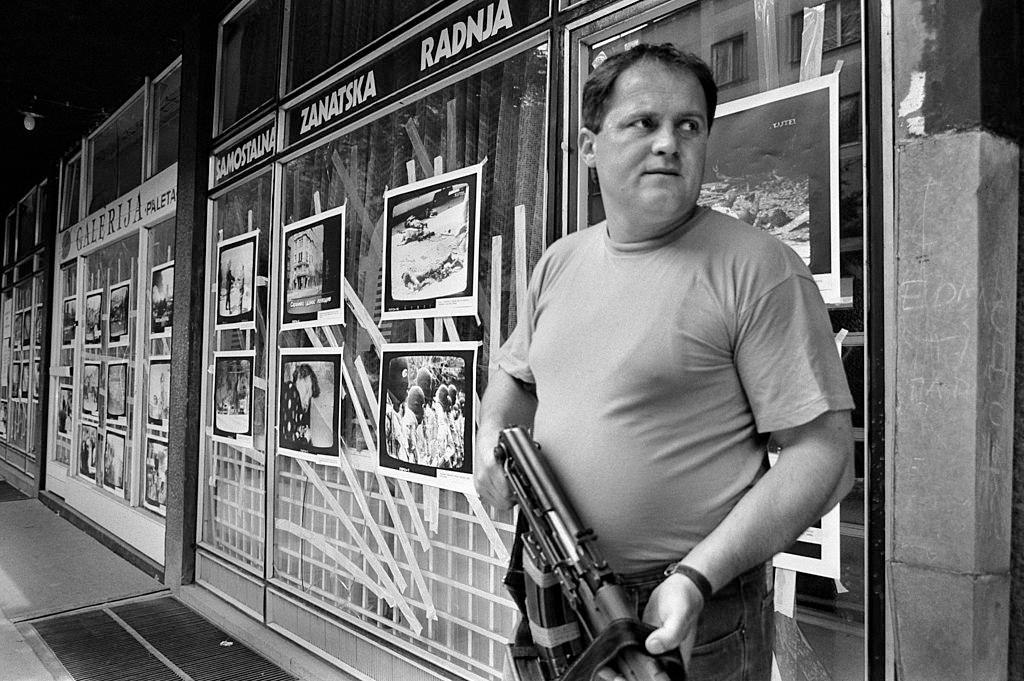
Outside a shopfront marked with local signage, a Bosnian fighter grips an AK‑47 and keeps watch, his attention pulled toward something off-frame. Behind him, the windows have been turned into an impromptu display—photographs taped in rows, like a street-level bulletin board for a city trying to make sense of catastrophe. The contrast is stark: everyday commerce and pedestrian space on one side, the posture and hardware of civil war on the other.
Along the glass, images of bodies, rubble, and grieving crowds read as accusations as much as documentation, presented as evidence of massacres allegedly carried out by Serbian forces. The prints are arranged where passersby cannot ignore them, collapsing the distance between front-line violence and ordinary urban life. Even in black and white, the scene feels loud—paper edges, tape strips, and reflections competing with the hard silhouette of the rifle.
War photography often freezes combat, but this frame lingers on memory and messaging: how communities display suffering, assign blame, and demand recognition in real time. For readers interested in the Bosnian War, Balkan civil wars, and the visual culture of conflict, the photo offers a grim study in propaganda, testimony, and survival. It reminds us that battles are fought not only with weapons, but also with images—posted in public, argued over, and carried into history.