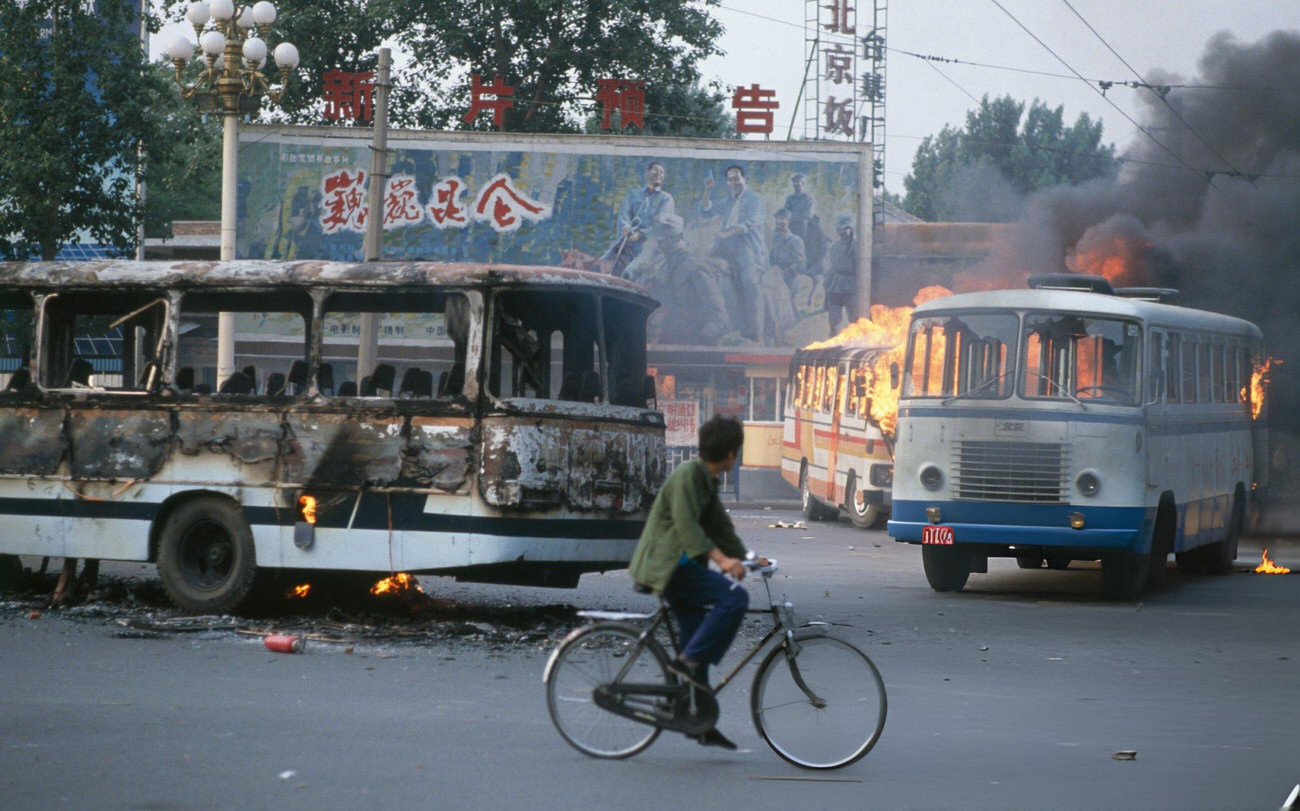
Smoke billows over a broad Beijing roadway where two buses burn, their windows blown out and frames scorched into dark skeletons. A lone cyclist rides past the wreckage, a small human figure set against the scale of fire and debris. In the distance, more flames lick at another vehicle, while a large wall mural and Chinese characters on a billboard loom above the scene, reminding the viewer that daily life and public messaging continued even as unrest surged.
Seven weeks into the 1989 student protest movement centered on Tiananmen Square, the atmosphere captured here hints at a city strained to the breaking point. The blazing buses and scattered fragments suggest barricades, confrontation, and the volatile edge where demonstration meets crackdown. Rather than focusing on a crowd, the photograph emphasizes the aftermath—what violence leaves behind in streets designed for transit, commerce, and routine.
For readers searching the history of Tiananmen Square protests, this image offers a stark visual counterpoint to more familiar scenes of banners and mass gatherings. It frames the movement not only as a political moment but as an urban crisis, where ordinary commuters navigated danger and uncertainty in real time. The result is an unsettling, SEO-relevant window into Beijing in 1989: student-led protest, civic unrest, and the combustible tension of a pivotal turning point.