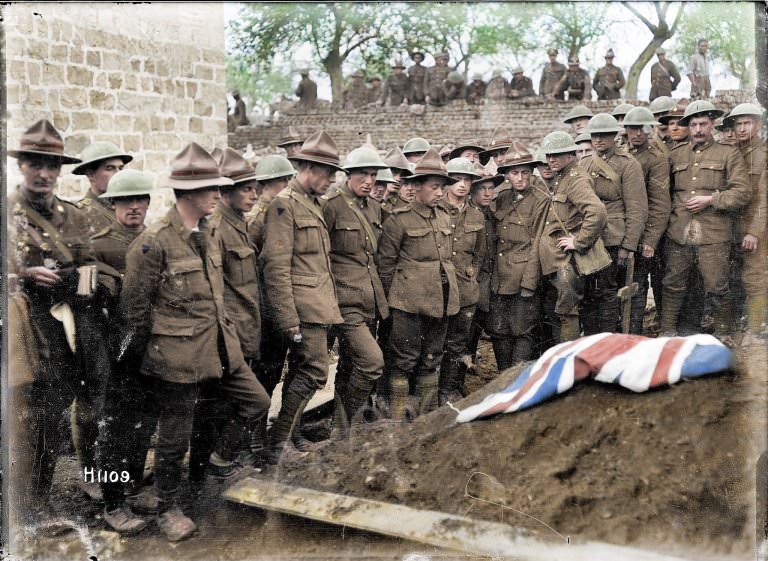
A tight ring of soldiers stands shoulder to shoulder at the edge of an open grave, their uniforms and helmets forming a muted wall of khaki against rough stonework and bare earth. In the foreground, a Union Jack draped over the coffin turns the scene into a stark focal point, the folds of fabric resting where words and speeches can’t reach. Faces tilt downward or stare ahead, caught in that suspended moment when a battlefield comrade becomes a memory.
Sergeant Henry Nicholas, VC, is named in the title, and the photograph’s power lies in how it translates that honour into human scale: men who look exhausted, attentive, and very young, gathered not for a parade but for farewell. The setting suggests a wartime burial in France during World War I, with a crowd watching from behind and above, as if the landscape itself has been pressed into service as a witness. No dramatic action is needed; the stillness, the packed ranks, and the raw ground tell the story.
Colorization softens none of the grief here—it sharpens it, bringing out the lived-in textures of cloth, dirt, and weathered masonry while making the flag’s colours feel freshly present. For readers searching for World War I funeral photos, Victoria Cross history, or British soldiers on the Western Front, this image offers an intimate glimpse of how loss was marked far from home. It is a reminder that even the most decorated acts of courage ended, all too often, in a simple grave surrounded by comrades who had to shoulder the war’s next day.