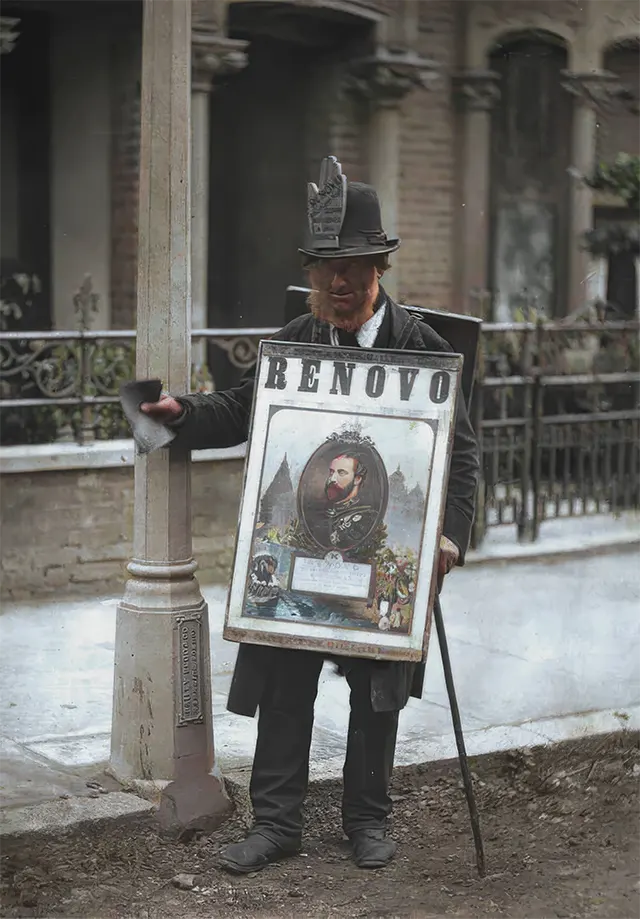
Lean and weathered, a London boardman stands at the edge of the pavement with a stout walking stick and a bundle of handbills ready to pass along. The colorization brings forward the textures of his working clothes and the familiar silhouette of a bowler hat, placing him in the everyday street life of the 1890s rather than the grander scenes usually associated with Victorian London.
Strapped to his chest is the real attention-grabber: a large advertising board dominated by the bold word “BENOVO,” framing an ornate printed portrait and decorative flourishes. This kind of mobile marketing was a precursor to modern street teams and billboard campaigns, turning a person into a moving noticeboard who could stop, gesture, and hand out flyers to anyone willing to glance, listen, or buy.
Behind him, iron railings and brick façades suggest a residential street where commerce and domestic life rubbed shoulders, and where public space was constantly negotiated by pedestrians, hawkers, and advertisers. For readers interested in London history, Victorian advertising, and the visual culture of the late nineteenth century, the scene offers a grounded look at how products and performances were promoted—one step, one leaflet, and one passing stranger at a time.