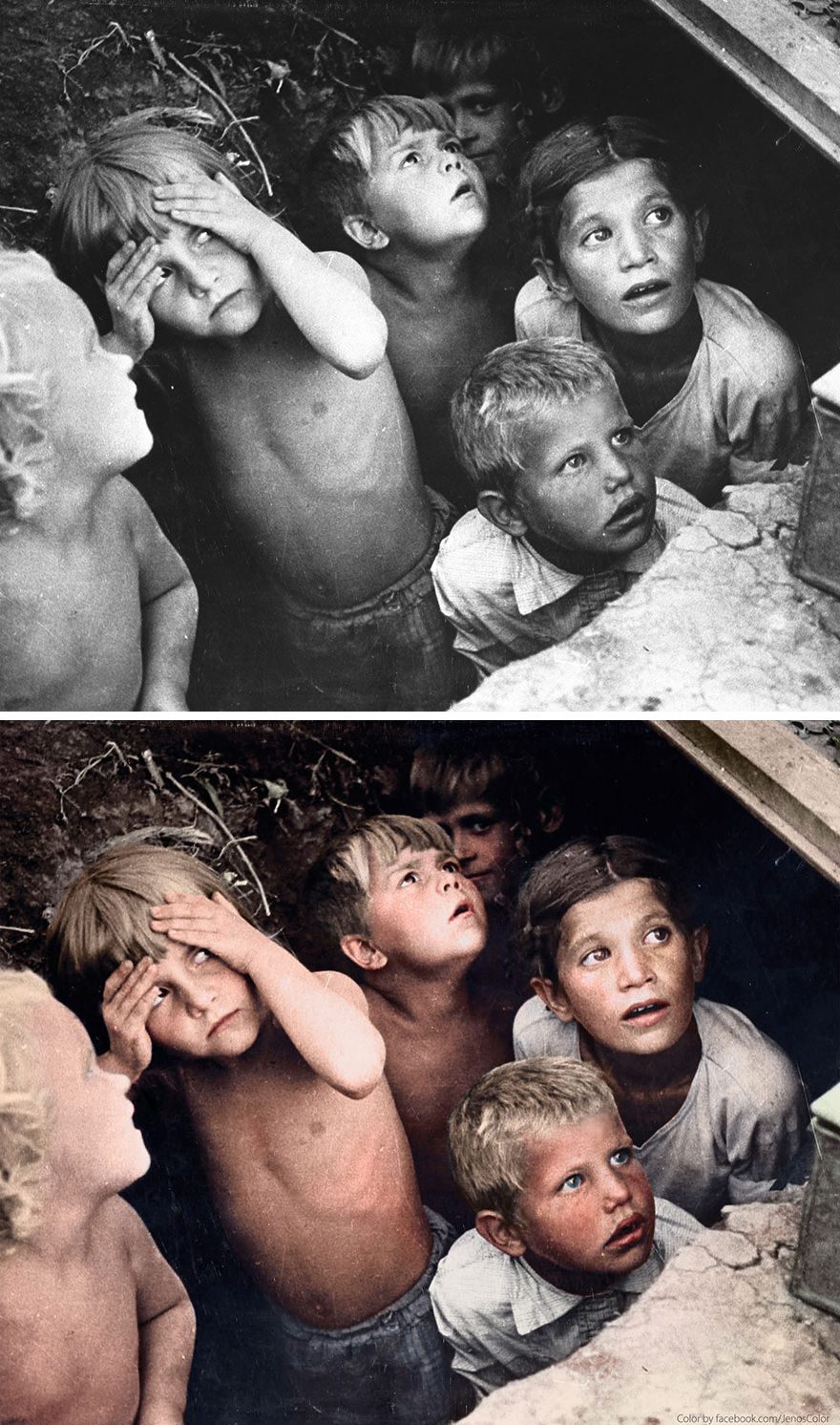
Huddled in a cramped shelter, a cluster of children crane their necks toward the light, eyes fixed upward as if trying to understand the roar beyond the frame. One shields his face with a hand, another stares open-mouthed, and a younger child presses close at the edge—small bodies packed together where earth and rubble become a hurried refuge. The tight composition turns the viewer into a witness, close enough to feel the airless tension of a moment when ordinary neighborhood life has been violently interrupted.
Set in Minsk, Belorussia, the scene is tied to the opening days of Operation Barbarossa in June 1941, when the German invasion of the Soviet Union brought sudden aerial bombardment to civilian streets. There are no soldiers here, no front line—only children, caught between curiosity and fear, listening and watching for what comes next. Their expressions carry the unsettling truth of wartime: history often arrives first as sound and shock, long before it is recorded in textbooks.
Colorization adds another layer to the photograph’s impact, pulling these faces out of the distant past and into something uncomfortably immediate. Subtle tones in skin, hair, and clothing emphasize how young they are, and how close the danger feels, while the earthen walls and jagged opening suggest a makeshift shelter rather than safety. For readers searching for World War II images of Minsk, Operation Barbarossa civilian experiences, or colorized historical photos, this picture stands as a stark reminder of what bombing meant on the home front—especially for children.