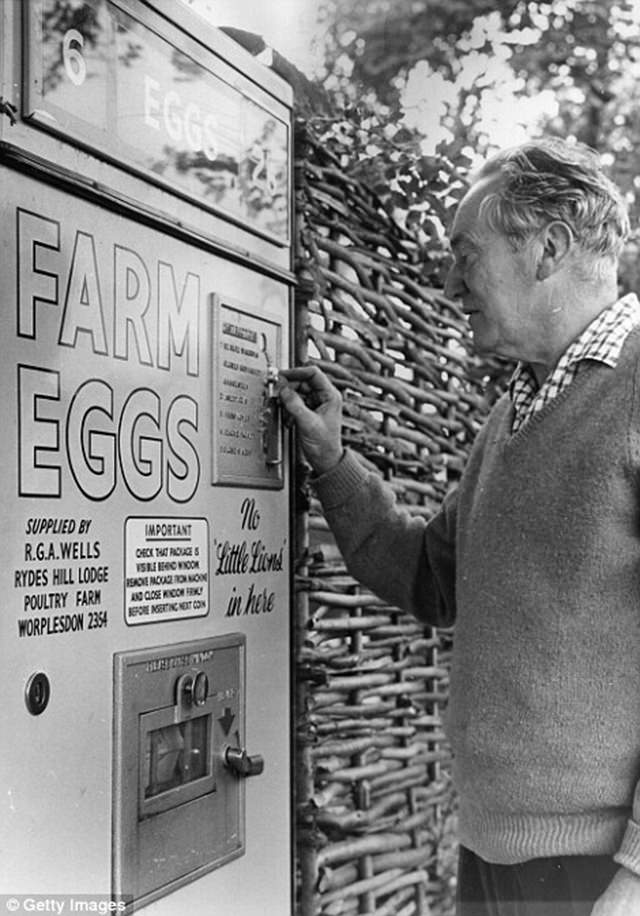
A sweatered customer stands close to an egg vending machine, studying the instructions as he reaches for the mechanism—an everyday purchase made slightly futuristic. Bold lettering advertising “FARM EGGS” dominates the metal front, while smaller notices hint at rules of use and the promise of reliable produce. The scene feels both ordinary and experimental, the kind of practical invention that quietly reshaped how people shopped.
Set in Surrey in 1963, the moment speaks to a growing appetite for convenience without abandoning the idea of freshness. Rather than queuing at a counter, the buyer interacts with a coin-operated dispenser designed to deliver a staple food quickly and consistently. It’s a small window into mid-century British life, when automation began appearing not just in factories, but in the routines of local communities.
Details in the frame—the utilitarian door, the printed guidance, and the no-nonsense branding—make this photograph a rich resource for anyone interested in the history of vending machines, rural commerce, and food distribution. There’s also a quiet charm in the contrast between the machine’s engineered simplicity and the traditional textures around it. For readers searching for “Surrey 1963,” “egg vending machine,” or “farm eggs in Britain,” this image offers a vivid, grounded glimpse of invention at work in the daily shop.