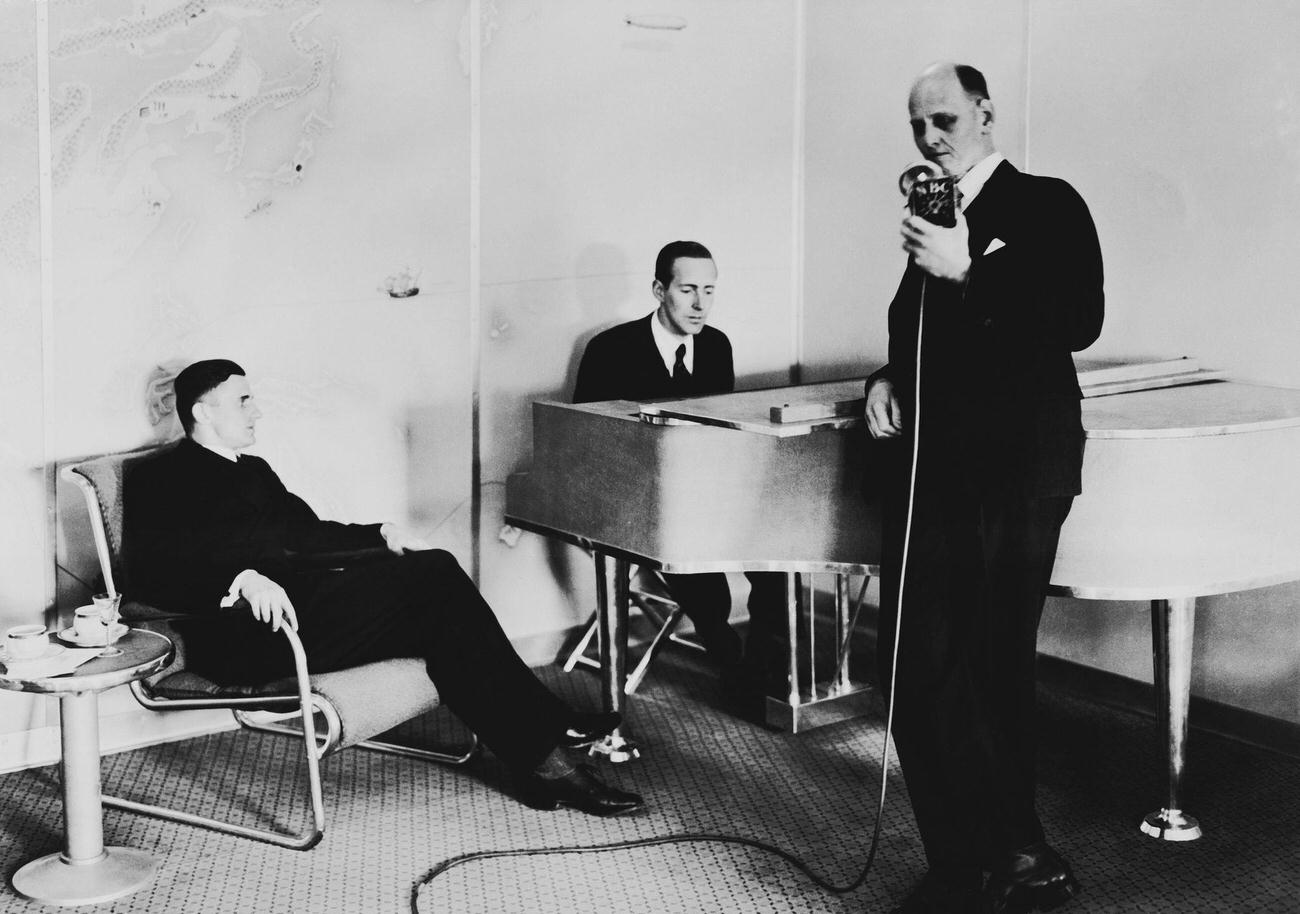
Soft light and sharp suits set the scene for an onboard performance where music and modern media share the same room. A pianist sits at a compact grand piano, hands poised for a recital credited to Franz Wagner, while a second man stands close to a wired microphone, concentrating on a live broadcast identified in the title as Max Jordan’s. Nearby, another figure reclines in a lounge chair beside a small table, lending the moment the feel of a private salon rather than a public stage.
Details in the photograph underline the era’s fascination with “inventions” that made distance shrink: the long microphone cable across the carpet, the sleek instrument, and the pared-down interior designed for comfort in transit. A wall map—likely a navigational chart—quietly hints at travel and coordination beyond the frame, tying the scene to the Hindenburg mentioned in the post title. Together, the objects create a snapshot of 1930s technology at work, when radio could turn an intimate recital into an event heard far away.
For readers interested in radio history, airship culture, and early broadcast performance, this image offers a striking intersection of entertainment and engineering. The contrast between the relaxed listener, the focused pianist, and the announcer addressing the microphone captures how new media reshaped ordinary moments into shared experiences. It’s an evocative reminder that aboard iconic machines like the Hindenburg, leisure, publicity, and communication often traveled side by side.