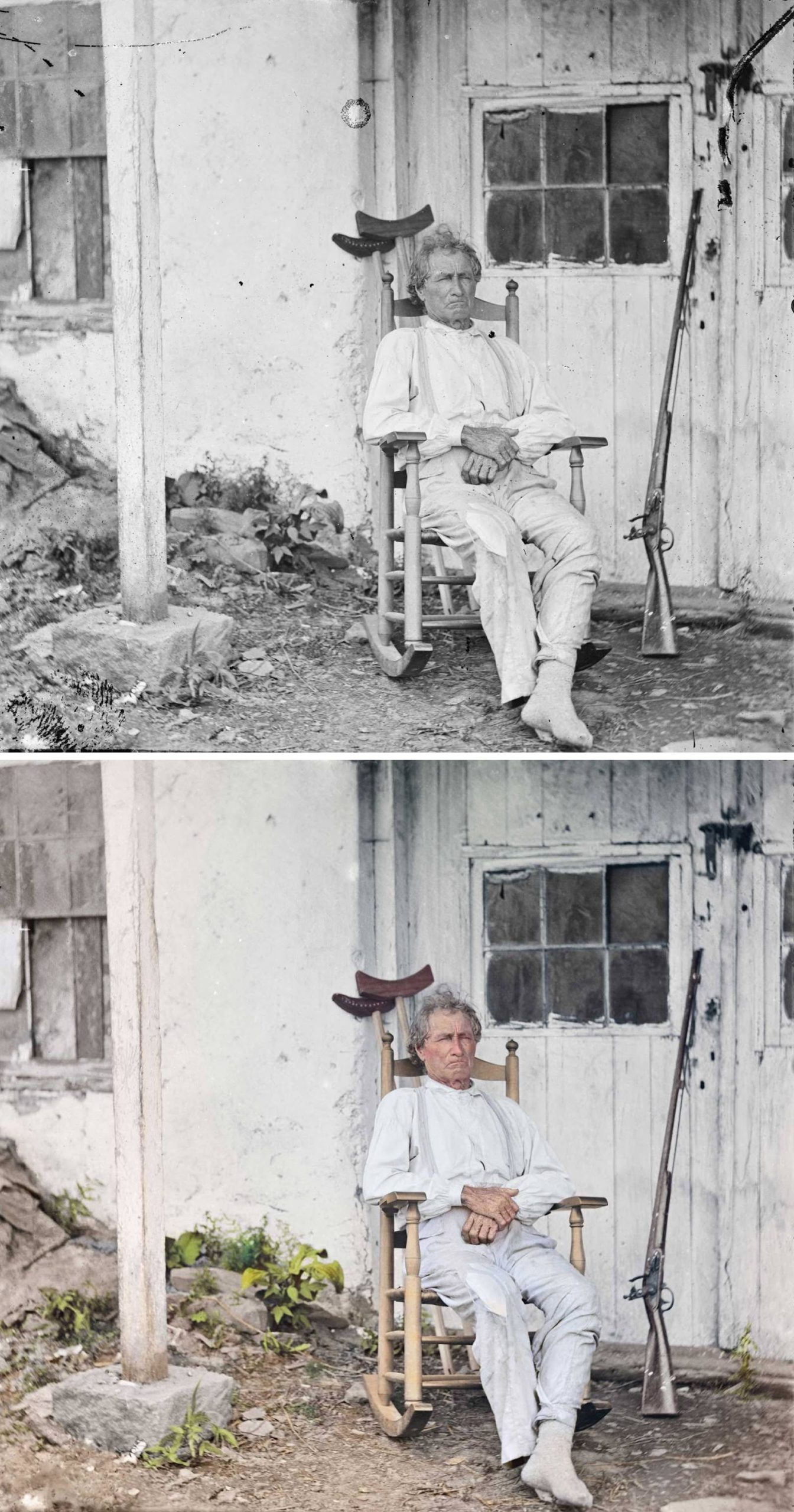
John L. Burns sits outside a plain wooden building in Gettysburg, Pennsylvania, his posture heavy with fatigue and resolve. A long gun is propped at his side, while crutches frame him as both support and statement, turning the porch into a small stage for Civil War memory. The composition is spare—weathered boards, a window, a patch of earth—yet it keeps the eye returning to the man who became known as the “old hero of Gettysburg.”
Nothing here feels theatrical in the modern sense; the power comes from the quiet contrast between weapon and injury. Burns’ face is set, his hands resting in his lap, as if the battle has ended but the cost still presses close. Even the rocking chair suggests a hard-earned pause rather than comfort, grounding this Gettysburg photograph in the lived aftermath of July 1863.
For readers interested in the Battle of Gettysburg and the wider story of civilians in the American Civil War, the image offers a vivid reminder that heroism was not limited to uniforms. The title’s details—gun, crutches, Gettysburg, and the month of July 1863—anchor the scene in a moment when news, legend, and personal suffering collided in a small Pennsylvania town. As a historical photo, it works both as documentation and as an early piece of wartime storytelling, preserving how the “old hero of Gettysburg” was meant to be seen.