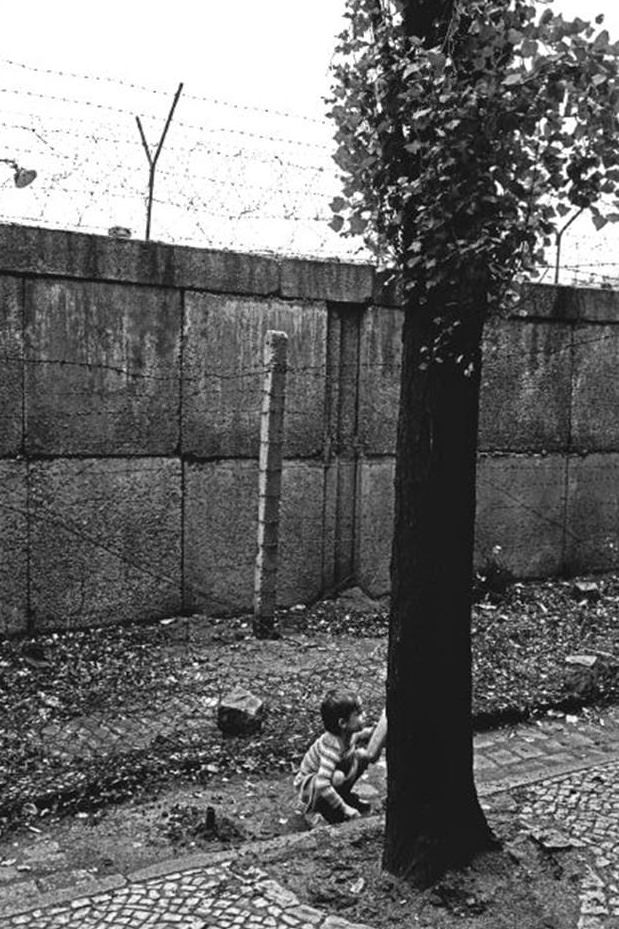
Against the hard slab of the Berlin Wall, a small child crouches near a tree in Wedding, turning a bleak border zone into a makeshift playground. Barbed wire crowns the concrete, and the ground below—strewn with rubble and broken pavement—suggests a city still living with daily division. The contrast is striking: the child’s absorbed play set beside architecture built to enforce separation.
In Berlin’s Cold War years, neighborhoods like Wedding sat close to the frontier where ordinary routines met extraordinary restrictions. The Wall here isn’t an abstract symbol; it is a looming presence at street level, part barrier and part backdrop to childhood, shaping what “outside” meant and where play could happen. Small details—the cracked curb stones, the chain-link fence, the stark verticals of concrete and wire—quietly underline how fortified the landscape had become.
Stories of conflict often focus on leaders and crises, yet photographs like this keep the human scale in view, where resilience appears in everyday gestures. For readers searching Berlin Wall history, Berlin Wedding, or life in divided Berlin, this scene offers an intimate reminder that even in tense borderlands, children found ways to play. It’s a sobering, tender glimpse of how a city’s political fault line ran straight through ordinary streets and childhood memories.