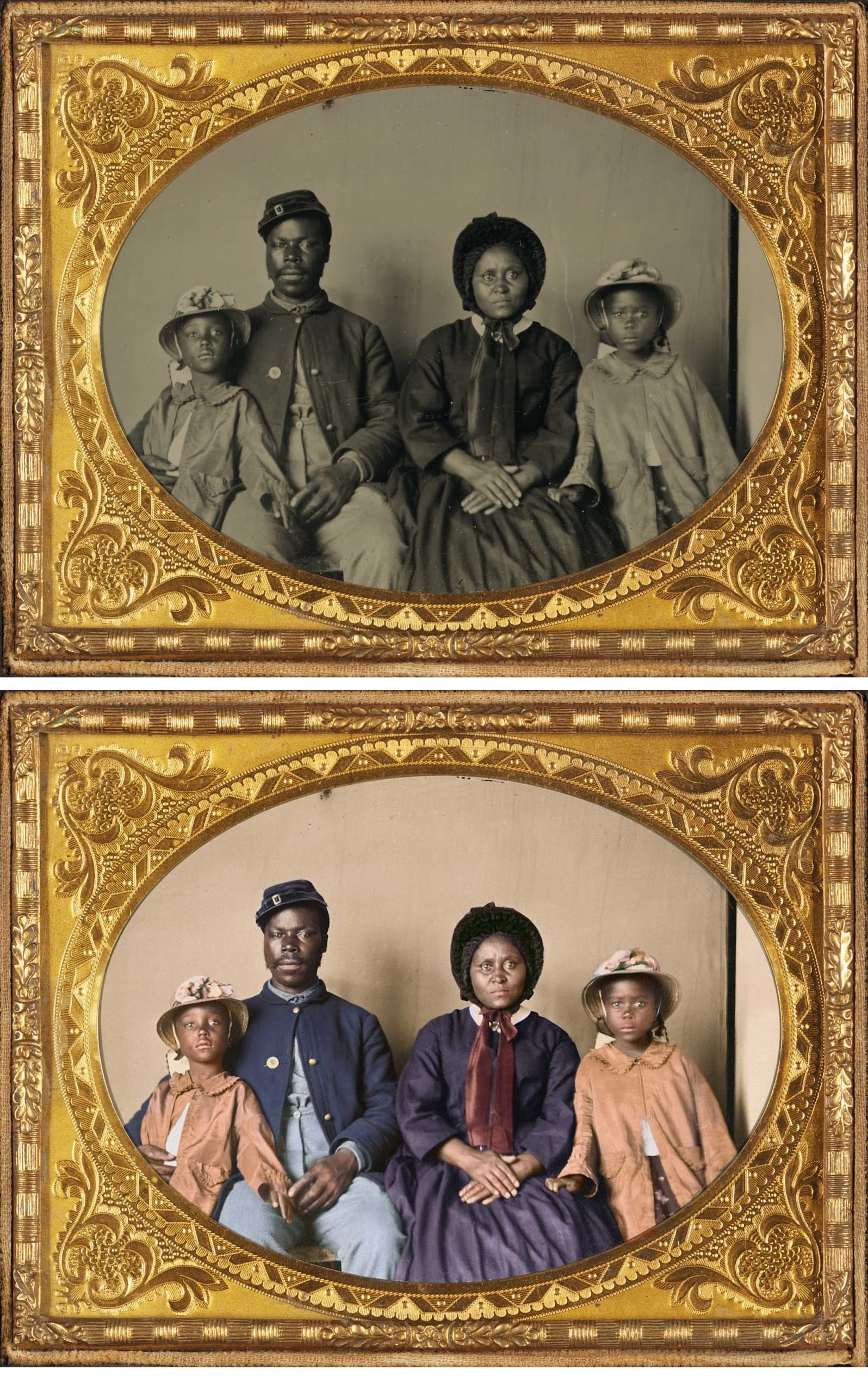
Framed by an ornate oval mat, a Union soldier sits beside his wife with two young daughters positioned at either side, forming a careful family tableau from the Civil War era. The man’s dark military jacket and cap, marked with bright buttons, contrast with the women’s soft capes and brimmed hats, details that speak to both wartime necessity and a desire to appear one’s best for the camera. Their direct gazes and composed posture suggest the seriousness of the moment, as if the photograph were meant to stand in for presence when separation and uncertainty were constant.
Clothing and pose do much of the storytelling here: the soldier’s uniform signals service and new claims to citizenship, while his wife’s bonnet and ribboned neckwear anchor the portrait in domestic life. The daughters’ matching outer garments and hats hint at parental care and the importance of respectability, even amid the disruptions of conflict. With no names attached, the family remains unidentified, yet the visual evidence places them firmly within the history of African American participation in the Union war effort between 1863 and 1865.
Within the broader “Civil Wars” story, this portrait reads as both personal keepsake and historical document, reflecting how Black families used photography to assert dignity, kinship, and belonging. The gold-toned presentation and studio backdrop underscore the formal nature of nineteenth-century portraiture, where every prop and fold of fabric carried meaning. For readers searching Civil War photographs, African American Union soldiers, and family portraits of the era, this image offers a quiet, powerful entry point—one that invites questions about service, home, and the lives recorded without full identification.