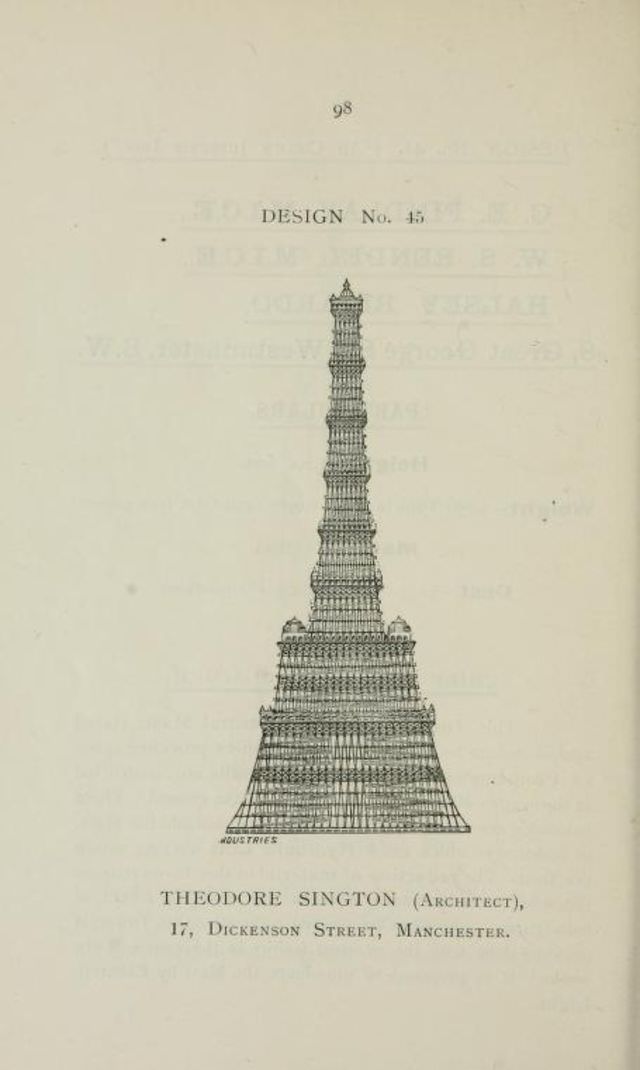
Victorian London’s appetite for spectacle and engineering ambition sparked a flood of proposals for a “Great Tower,” and the surviving design sheets read like a catalog of late‑19th‑century invention. On this page, labeled “Design No. 45,” a steeply tiered structure rises from a broad base into a needle-like summit, built up in disciplined bands that suggest observation decks, galleries, and ornamental belts. The drawing’s careful symmetry and dense latticework evoke the era’s fascination with iron, industry, and the possibility of building higher than ever before.
Printed beneath the illustration is the credit line “Theodore Sington (Architect),” with an address in Manchester, a reminder that these competitive submissions were not only a London story but a national conversation among designers, builders, and dreamers. The sheet itself—numbered like part of a larger bound set—feels like evidence from an architectural contest, where dozens of rival visions competed on paper for attention, funding, and prestige. Even without a surviving model, the proposal communicates confidence: a monumental base to anchor the skyline, then a sequence of narrowing stages that turn structural logic into spectacle.
For readers interested in 1890 inventions, unbuilt London landmarks, and the history of competitive architecture, this image offers a vivid snapshot of how the future was negotiated in ink and print. It also makes a compelling SEO-friendly window into topics like Victorian engineering, Great Tower designs, and the culture of public competitions that shaped modern urban imagination. Browse the details, and it’s easy to see why more than 50 entries could be proposed—each one a different answer to the same question: what should a modern tower look like when an empire wants to reach the sky?