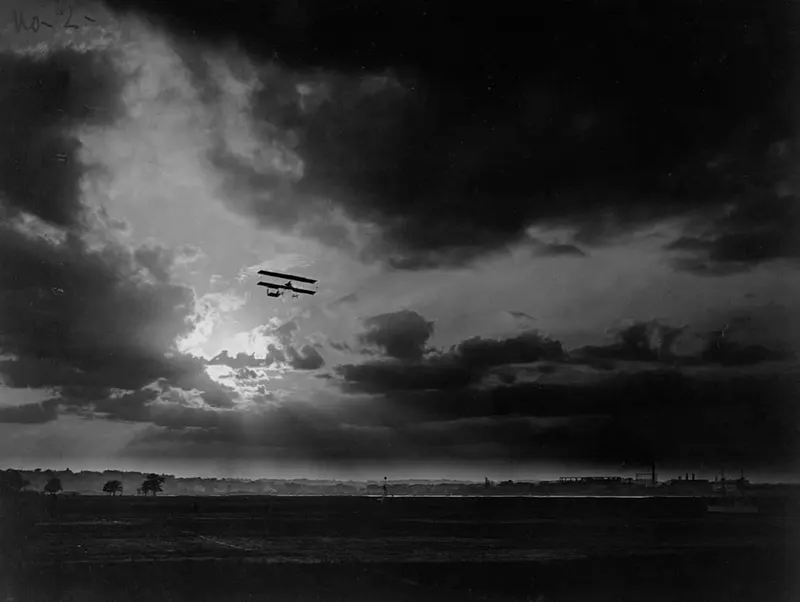
Against a brooding French sky, an early biplane cuts a thin silhouette as it holds steady above a wide, darkened landscape. The dramatic cloud cover turns the aircraft into a stark outline, emphasizing how light and exposed these pioneer machines were—wood, fabric, wire, and faith in the new science of flight. Even without close detail, the proportions and stacked wings evoke the experimental confidence of 1910 aviation.
At ground level the scene feels almost empty, the horizon stretching flat with only small marks of distant structures to anchor the view. That scale matters: it reminds us how unfamiliar powered flight still was, a spectacle that could transform open countryside into an impromptu airfield and a brief ascent into a public event. The biplane’s smallness against the weather suggests both risk and triumph, a single craft testing the air in conditions that look anything but forgiving.
In the story of inventions, photographs like this help explain why early aviation captured imaginations so quickly in France and beyond. The image pairs technical ambition with the raw theater of nature—cloud, light, and altitude—making the machine’s achievement feel hard-won rather than inevitable. For readers searching early biplane history, French aviation in 1910, or the dawn of powered flight, this moment offers a vivid reminder of how quickly the twentieth century learned to leave the ground.