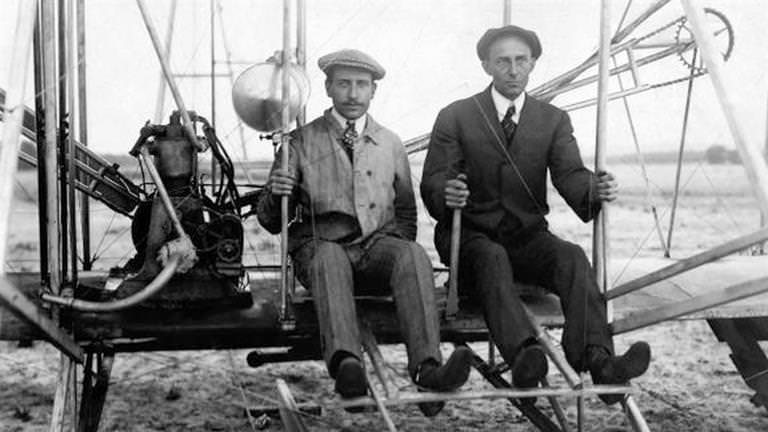
Leaning into the skeletal frame of an early flying machine, Wilbur Wright and Orville Wright sit side by side with the steady, unsentimental posture of inventors at work. The open lattice of struts and wires fills the foreground, while the sparse landscape behind them underscores how experimental aviation began far from ornate workshops or grand terminals. In a single glance, the photograph balances human presence with the fragile geometry of a craft still defining what an “airplane” could be.
To the left, the exposed engine and mechanical parts stand out as much as the men themselves, inviting the viewer to read the image like a diagram of practical problem-solving. Every cable, brace, and joint looks purposeful, a reminder that controlled flight depended on careful design as much as daring. That straightforward, utilitarian look is precisely what makes this 1903 airplane scene so compelling for anyone interested in early aircraft engineering and the birth of powered aviation.
Placed in a WordPress post about inventions, this historical photo works as both evidence and atmosphere: it shows innovation in its raw, hands-on stage, before aviation became polished and standardized. Searchers drawn to Wilbur and Orville Wright, the Wright brothers’ airplane, and early flight history will recognize the iconic combination of pioneering figures and their machine. More than a portrait, it’s a window into an era when the future was built from wood, wire, and confidence.