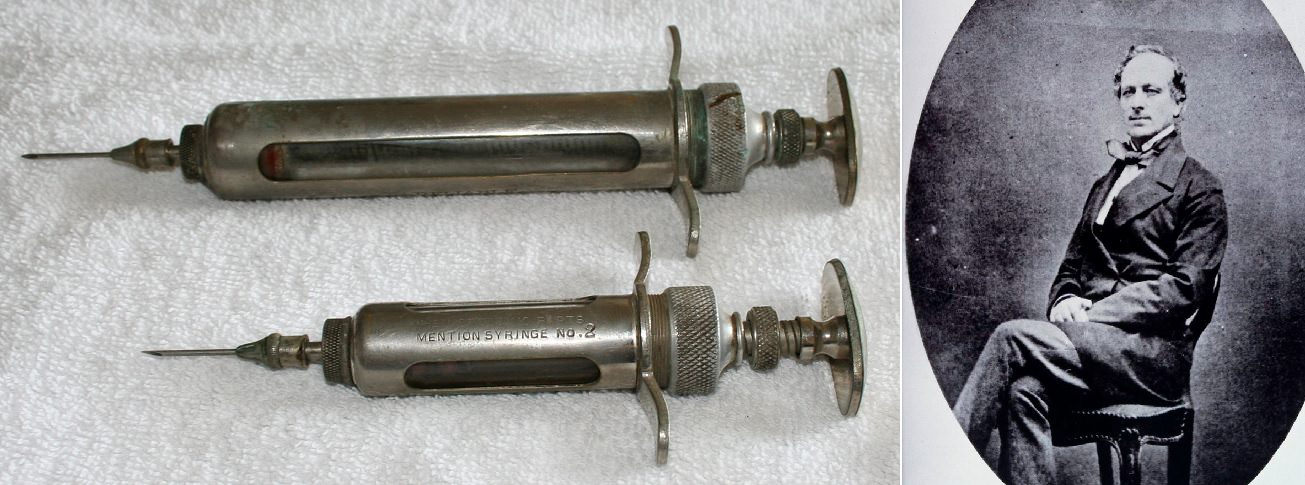
Brass-toned instruments lie side by side on a pale cloth, their long barrels and sharpened needles pointing with unmistakable purpose. These are early hypodermic syringes associated with Francis Rynd in the 1850s, showing an era when medical tools were still engineered like fine mechanical devices—knurled grips, threaded fittings, and sturdy plungers meant to be handled with precision. An engraving on one barrel hints at careful cataloging and manufacture, underscoring how quickly this “invention” became a standardized piece of equipment.
Across the composition, a formal portrait of a seated man anchors the story in the people behind the technology, reminding viewers that breakthroughs in medical history are inseparable from the clinicians and experimenters who pushed treatments forward. The contrast between the cool, utilitarian metalwork and the dignified studio photograph creates a small timeline in a single frame: innovation on one side, its human context on the other. Together, they evoke the mid-19th-century drive to make medicine more targeted, controlled, and immediate.
For readers interested in the history of medicine, early anesthesia and pain management, or the evolution of surgical instruments, this image offers a compelling look at the beginnings of injection technology. The hypodermic syringe would go on to reshape clinical practice by enabling drugs to be delivered beneath the skin with speed and measurable dosage. Seen up close, these pioneering devices reveal both the ingenuity and the seriousness of a period when modern medical treatment was taking its recognizable form.