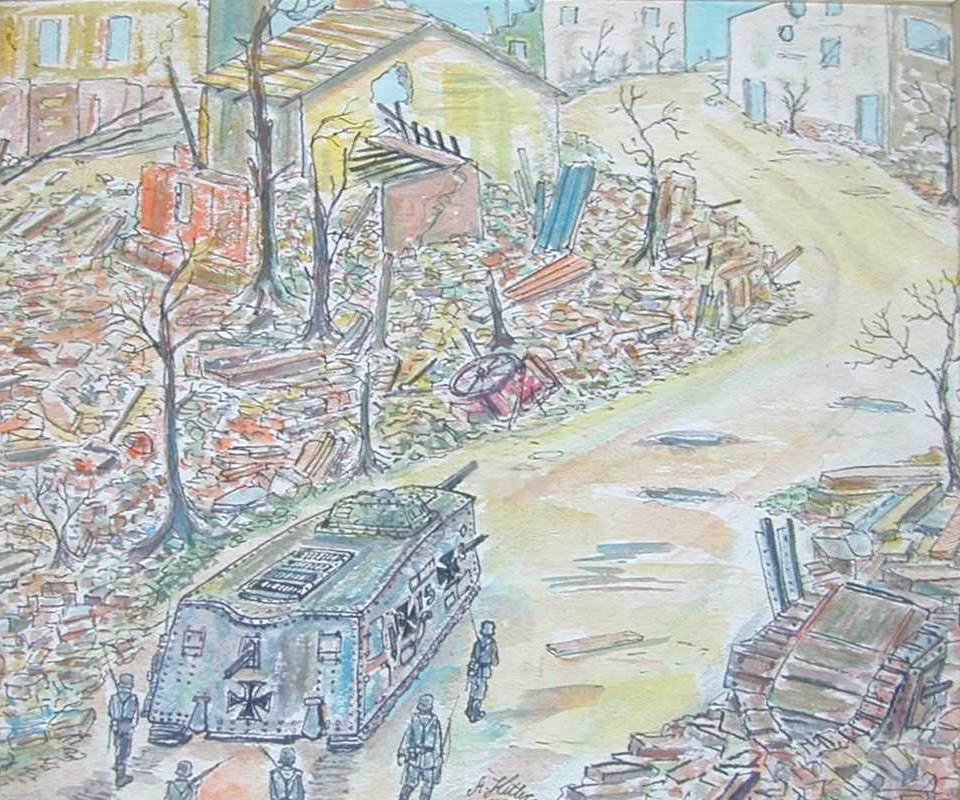
Along a broad, battered street, an armored vehicle crawls forward under the watch of scattered soldiers, its angular hull and iron cross emblem making a stark focal point against the pale roadway. On both sides, the city is reduced to a jagged shoreline of brick and timber, with leafless trees rising like charred markers among collapsed walls. The scene reads as a patrol route carved through ruin—quiet, exposed, and tense.
Rubble dominates the foreground and background alike: broken masonry, splintered beams, and fragments of fencing spill into the gutters where sidewalks once guided everyday life. The hand-drawn, watercolor-like treatment softens the devastation just enough to draw the eye into details—open window holes, torn rooflines, and scattered household remnants—suggesting how abruptly the ordinary was interrupted. Even without a named place, the composition evokes urban warfare’s familiar aftermath, when movement becomes cautious and every intersection feels contested.
“Tank Patrol” works both as artwork and as visual document, capturing the uneasy rhythm of occupation and survival in a shattered townscape. For readers drawn to military history, armored vehicles, and wartime street scenes, it offers a compelling study of how tanks and infantry were used to push through destroyed neighborhoods. The image invites reflection on what patrol meant in such conditions: not triumphal parade, but careful progress through silence, debris, and uncertain horizons.