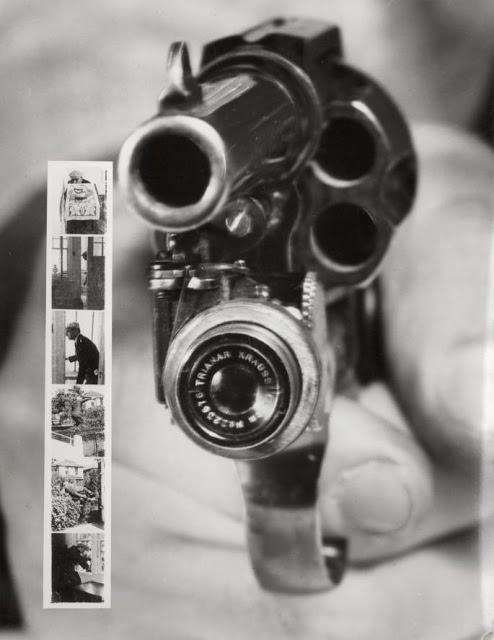
At first glance it feels like a firearm pointed straight at the viewer, yet the giveaway is the glassy lens nestled beneath the barrel-like housing. The title, “The Revolver Camera, 1938,” fits perfectly: a compact, pistol-grip body with a rotating cylinder design that echoes a revolver, engineered to make photography feel fast, modern, and almost tactical. In the blurred background, a hand steadies the device, underscoring how portable and “ready-to-shoot” this invention was meant to be.
Along the left edge, a narrow strip of tiny frames reads like a contact sheet, hinting at the kind of candid sequences such a camera could produce. Those miniature images suggest quick snapshots taken in motion—everyday scenes and figures caught mid-action—reinforcing the promise of speed that often accompanied interwar-era gadgetry. The juxtaposition of weapon-like form and photographic function also speaks to the era’s fascination with machinery, novelty, and the thrill of new consumer technology.
For collectors and history buffs, this 1938 revolver camera photograph offers more than a quirky design; it’s a window into how inventors and marketers reimagined the act of taking pictures. The close-up composition emphasizes metal contours, circular openings, and the prominent lens, making it ideal for readers searching for unusual cameras, vintage inventions, or early portable photography. Whether viewed as clever engineering or unsettling symbolism, the revolver camera remains a striking reminder that the history of imaging is full of bold, unexpected experiments.