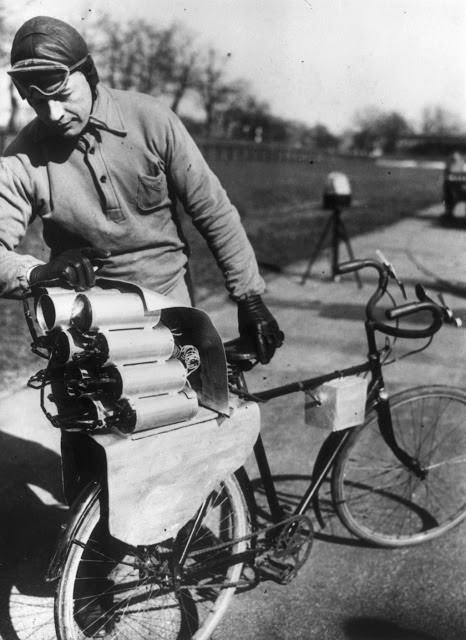
Leather gloves and a snug cap give the rider the look of a test pilot, yet he’s standing over something as ordinary as a bicycle—until your eye catches the bulky rocket-like cylinders mounted over the front wheel. The contraption turns a familiar frame into an experiment in speed, with a shielded cluster of tubes and fittings that suggests controlled ignition rather than simple pedal power. In this 1931 invention scene, the boundary between backyard tinkering and serious engineering feels remarkably thin.
At the curbside, the bike’s slim tires and upright handlebars contrast sharply with the heavy hardware strapped to its nose, hinting at the practical challenges of balance, steering, and safety. A small tripod-like device in the background and the open roadway beyond add to the sense of a public test or demonstration, where curiosity may have outweighed caution. Even without technical diagrams, the photograph communicates the era’s confidence that any everyday machine could be made faster with enough ingenuity.
Rocket-propelled bicycles belong to a wider interwar fascination with propulsion, modern transport, and daring prototypes that flirted with the sensational. For readers interested in early experimental vehicles, vintage inventions, or the history of personal mobility, this image offers a vivid snapshot of ambition on two wheels. It’s the kind of oddball innovation that makes you wonder not only whether it worked, but how anyone planned to stop.