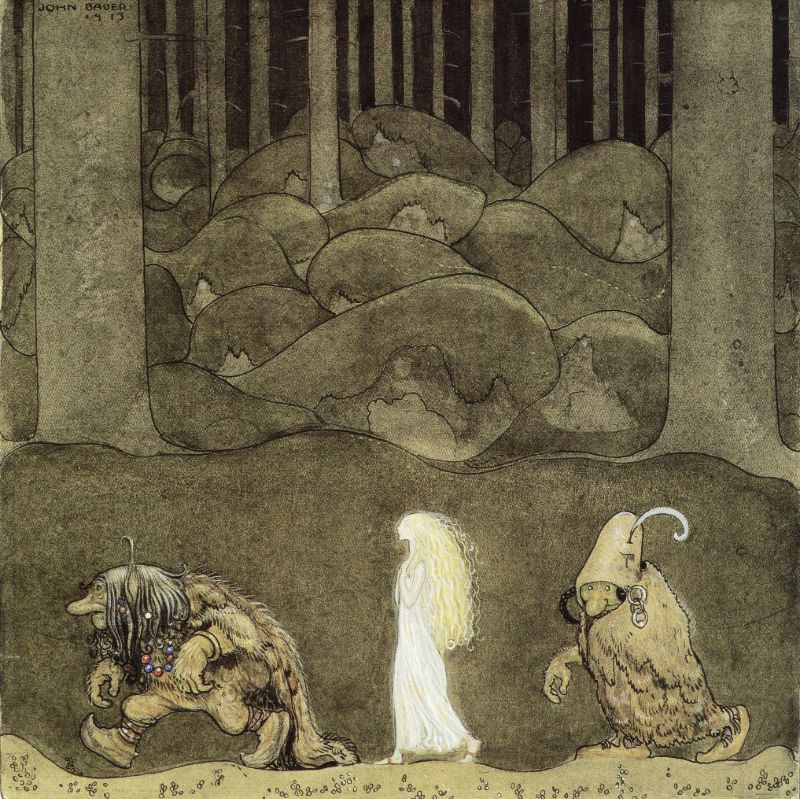
Beneath a wall of tall, straight tree trunks, a pale, glowing childlike figure stands at the edge of a shadowed forest floor, hair rendered as a soft cascade of light. On either side crouch two squat, furred beings with rounded bodies and curled tails, their faces part-human, part-folk tale, as if they’ve stepped out of an old legend and into a quiet standoff. The muted browns and mossy greens keep the scene hushed, while the white figure becomes the undeniable focal point—an uncanny presence in a world of earth and bark.
“The Changelings, 1913” leans into the long European tradition of stories about children exchanged by otherworldly creatures, and the composition plays that tension with restraint. One creature wears what looks like a string of beads, adding a domestic, almost ordinary detail to an otherwise unsettling meeting; the other, crowned with a curling tuft, watches with wary curiosity. Behind them, rounded, boulder-like forms pile up into a natural barrier, turning the forest into a stage set where the viewer feels invited to interpret motives rather than be told them.
As an early-20th-century artwork, this image fits comfortably in a moment when illustration and fine art often borrowed from folklore, fantasy, and the psychological edge of the fairy tale. The linework is delicate but deliberate, outlining every curve of fur and stone while letting the darkness of the woods swallow depth and distance. For readers searching for “The Changelings 1913” or exploring vintage fantasy illustration, this post offers a striking example of how myth can be rendered with both tenderness and menace—quietly eerie, yet irresistibly narrative.