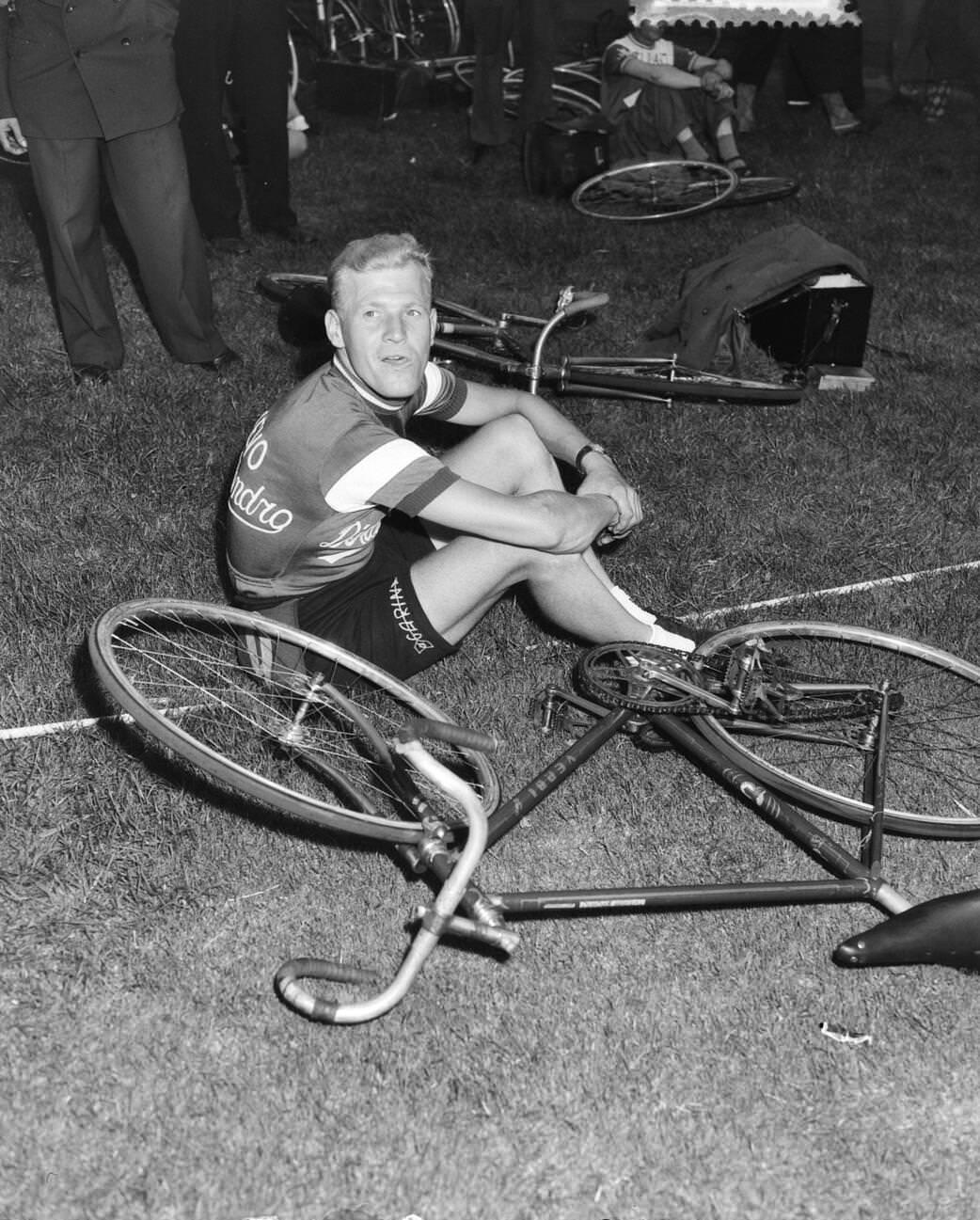
Grass and floodlights set the stage as a Tour de France rider sits upright on the infield, looking toward the camera with the startled calm of someone just brought to a halt. His bicycle lies splayed in the foreground, handlebars and wheels turned at awkward angles, while a scattering of gear and another bike behind him hint at the organized chaos that follows a crash or sudden stop. Around the edges, suited figures and teammates form a loose ring, turning a private moment of recovery into a public spectacle inside the Olympic Stadium.
The title places us in 1953, when the Tour’s team culture and tight logistics were as important as the climbing and sprinting. You can read the era in the details: the wool jersey, the simple machine with narrow tires and minimal components, and the absence of helmets that later generations would consider essential. Stadium finishes carried their own drama, compressing days of road racing into a final, amplified scene where fatigue, speed, and nerves all converged.
For historians of cycling, images like this are invaluable because they reveal the sport between the headlines—mechanics, mishaps, and the human face of endurance racing. The Olympic Stadium backdrop also underlines how the Tour de France sought grandeur and visibility, borrowing the architecture of international sport to frame its own myths. Whether you arrive here searching for Tour de France history, 1950s sports photography, or the lived texture of mid-century road racing, the photograph offers an immediate, tactile connection to that world.