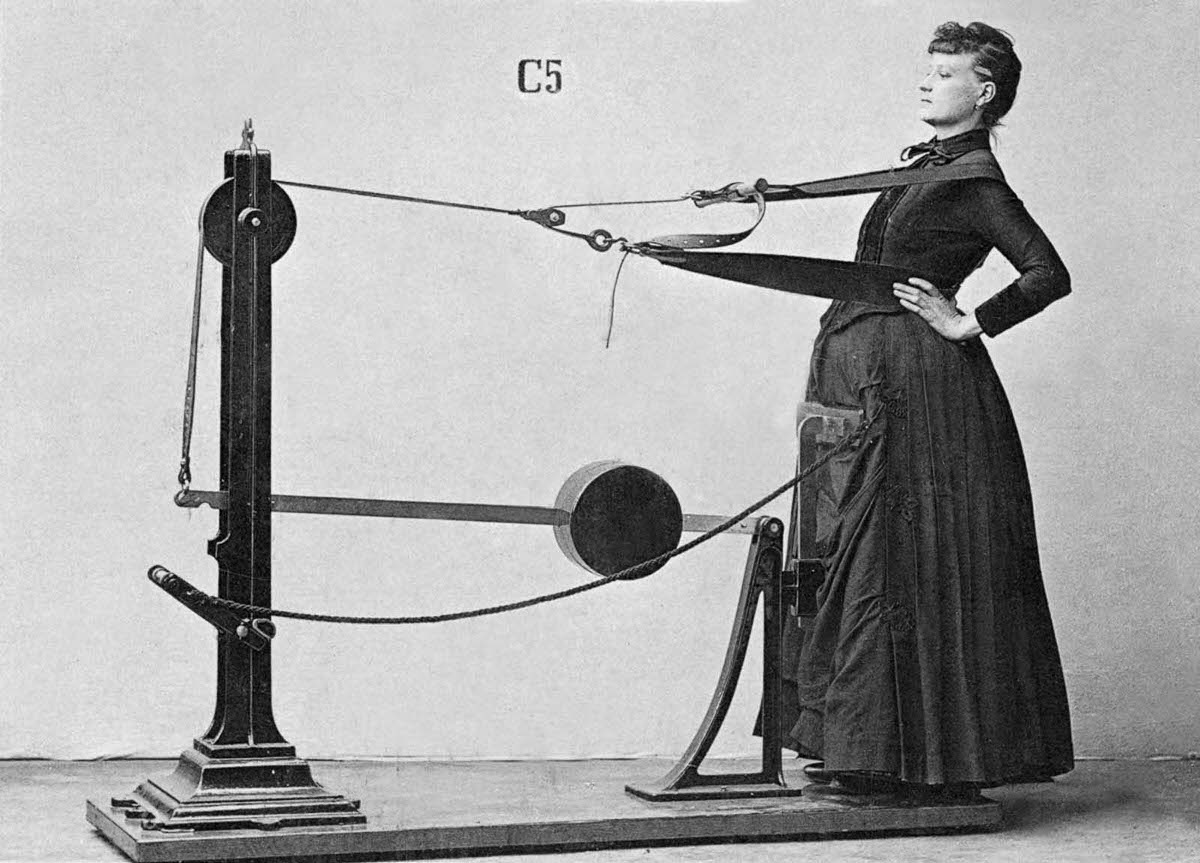
A poised young woman stands side-on to a belt-and-pulley exercise apparatus, one hand set on her hip as the other reaches forward to grip a handle connected by taut cord. Marked “C5” above her head, the studio-like setting turns her body into a diagram: shoulders squared, chest lifted, and torso subtly opening as the mechanism offers controlled resistance. The long skirt and high-collared blouse anchor the scene in an earlier era, when “physical culture” promised better posture and renewed energy through orderly movement.
Schoolroom fatigue and stiffness—so familiar in the post’s title—were often blamed on hours of sitting, heavy books, and rigid desks, and inventors responded with devices meant to counteract that strain. Here, the focus is on torso-stretching: a guided pull that encourages the spine to lengthen while the arms and upper back do their quiet work. The machine’s wheels, straps, and adjustable lines suggest a system designed to standardize exercise, turning a simple stretch into something measured, repeatable, and, in its own way, modern.
For readers interested in the history of inventions and early fitness technology, this photograph offers a fascinating blend of mechanics and self-improvement rhetoric. It hints at a moment when health advice migrated from manuals and classrooms into engineered equipment, promising revitalization through a few disciplined minutes of motion. Whether viewed as a genuine aid for posture or a clever contraption from the age of ingenuity, the image underscores a timeless idea: even a small stretch can change how the body feels after a long day.